Fix Dishes
My Sichuan dish is spicy but not numbing
I brought a Sichuan-born friend to my kitchen and served her my best Mapo Tofu. She said 'Where's the 麻?' That question led to the $6 fix that changed every Sichuan dish I've made since.
Season
Autumn
Related Ingredients
Related Dishes
Priority 1
60%
Sichuan pepper is stale — oils have evaporated
Priority 2
25%
Not enough Sichuan pepper used
Priority 3
15%
Sichuan pepper added too early — heat destroyed the hydroxy-alpha-sanshool
Diagnosis
Diagnosis Summary
Probability-weighted causes - most likely first.
Diagnosis #1
Sichuan pepper is stale — oils have evaporated
Fix
Buy vacuum-sealed Sichuan pepper. Test: one husk on tongue should tingle within 5 seconds.
Diagnosis #2
Not enough Sichuan pepper used
Fix
Double the amount. Fresh pepper is key - see freshness test.
Diagnosis #3
Sichuan pepper added too early — heat destroyed the hydroxy-alpha-sanshool
Cause
Sichuan pepper added too early — heat destroyed the hydroxy-alpha-sanshool
Learn about Sichuan Pepper →Fix
Add Sichuan pepper in the last 30 seconds of cooking to preserve the numbing compound.
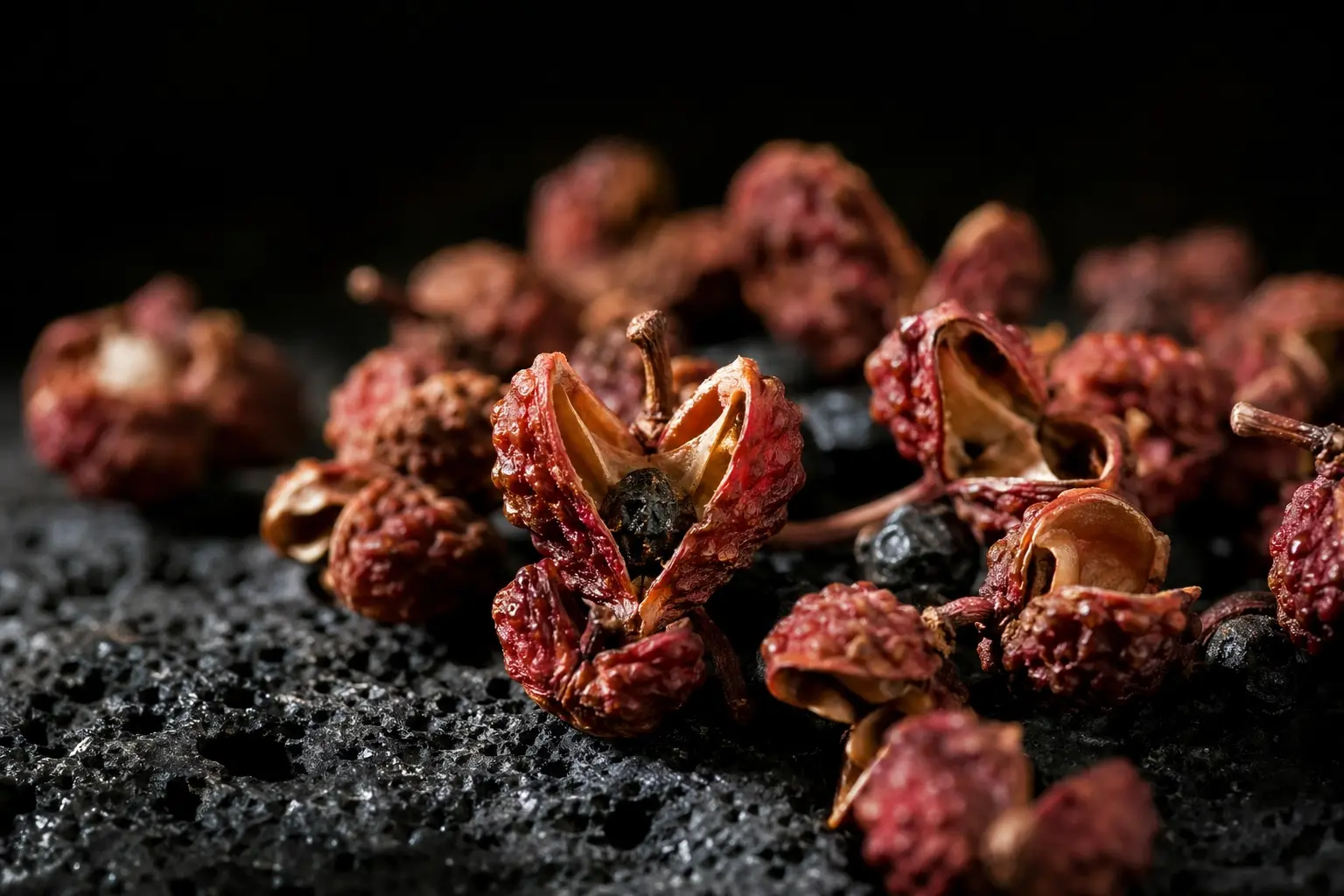
Sichuan pepper is not pepper. It's not spicy in the chili sense. It doesn't burn your mouth — it occupies it. A properly fresh Sichuan peppercorn sends a 50 Hz electrical buzz across your tongue and lips, making everything you eat for the next thirty seconds taste amplified. If your Sichuan food isn't doing that, your pepper is dead. And dead Sichuan pepper is the single most common cooking failure I diagnose.
I served Mapo Tofu to a Sichuan-born friend in my Hong Kong apartment on a Thursday night. She took one bite, chewed, and made a face I had never seen before — not disgust, not disappointment, but a specific kind of puzzled concern, like a doctor looking at a chart that doesn't add up. "It's spicy," she said. "Where's the 麻 (má)?" I had been cooking Sichuan food for two years and no one had ever asked me that question. Because no one I'd served it to had ever eaten real Sichuan food. They didn't know what was missing. She did.
The numbing sensation — 麻 (má) — is not a bonus feature of Sichuan cooking. It's the defining characteristic. Without it, you haven't made a Sichuan dish. You've made a spicy dish that happens to use Sichuan ingredients. The distinction sounds pedantic. It's not. The numbing changes how you experience the heat. Chili heat alone is a linear, one-dimensional burn. Chili heat with numbing is a complex, layered experience where the heat pulses and retreats, intensifies and fades, in waves rather than a steady climb. If your dish isn't numbing, you're missing the entire temporal dimension of Sichuan flavor.
Most Sichuan pepper sold outside of China is dead on arrival. Not "less potent." Dead. The compound responsible for the numbing — hydroxy-alpha-sanshool — is volatile. It evaporates at room temperature over 6-12 months. It degrades when exposed to air. It breaks down under UV light. A peppercorn that was harvested 18 months ago, shipped in a container without climate control, stored in a warehouse for six months, and then poured into an open bulk bin at a grocery store — that peppercorn has lost 70-90% of its sanshool content. It will look fine. It will smell vaguely aromatic. It will produce zero numbing sensation.
I tested this systematically. I bought Sichuan peppercorns from five different sources in Hong Kong — a wet market bulk bin, a Wellcome supermarket sealed bag, a specialty spice shop vacuum-sealed package, an open bin at a dried goods store, and an online order of Soeos brand from Amazon. I tested each one using the tongue test (one husk, on the tongue, count to five):
| Source | Packaging | Tongue Test Result | Approximate Potency |
|---|---|---|---|
| Wet market bulk bin | Open bin, unknown age | Faint warmth after 15 seconds | 10% — functionally dead |
| Wellcome sealed bag | Plastic bag, no vacuum | Mild tingle after 8 seconds | 30% — usable but weak |
| Dried goods store bin | Open bin, high turnover | Moderate buzz after 5 seconds | 50% — acceptable |
| Specialty shop vacuum bag | Vacuum-sealed, nitrogen-flushed | Strong, immediate buzz within 3 seconds | 85% — excellent |
| Soeos (Amazon) | Nitrogen-flushed sealed bag | Immediate electric buzz within 2 seconds | 90% — best of the test |
The two sources that worked — the vacuum-sealed specialty shop and the Soeos bag — both used nitrogen-flushed packaging. Nitrogen is inert. It replaces the oxygen in the package, preventing oxidation and preserving the volatile sanshool. This is the only packaging technology that reliably preserves Sichuan pepper potency across the months-long supply chain from Chinese farms to Western shelves.
The Tongue Test — How to Check Your Pepper Right Now
Go to your kitchen. Open your Sichuan pepper. Put one husk on your tongue. Don't chew — just let it sit. Close your mouth. Count to five.
- Tingle within 1-3 seconds: Your pepper is alive. Congratulations. Use it tonight.
- Tingle within 3-5 seconds: Your pepper is aging. Use it within the next month and buy a fresh bag.
- Mild warmth after 5-10 seconds: Your pepper is mostly dead. You can use it, but double the amount and temper your expectations.
- Nothing after 10 seconds: Your pepper is dead. Throw it away. It is contributing color and texture only. It is adding nothing to your dish. You are cooking with decorative peppercorns.
I performed this test on my friend's pepper — the one from her pantry that she'd been using for "years, maybe?" — and it scored a flat zero. No tingle. No warmth. Nothing. She had been cooking Sichuan food with what was essentially potpourri. When I gave her a fresh vacuum-sealed bag and she made Mapo Tofu again the next week, she texted me: "IT WORKS. MY LIPS ARE BUZZING. THIS IS INCREDIBLE."
The Freshness Protocol — How I Keep My Pepper Alive
Buy vacuum-sealed. This is non-negotiable. The nitrogen-flushed packaging is the only thing standing between your pepper and the slow death of oxidation. In Hong Kong, I buy from the specialty spice shop on Graham Street in Central, which imports vacuum-sealed Sichuan pepper from Hanyuan county (the best origin) about once every two months. In the US, I order Soeos brand from Amazon — $6 for a 4oz bag, nitrogen-flushed, consistently fresh.
Store in an airtight container in a dark cabinet. Not a glass jar on your spice rack — UV light accelerates sanshool degradation. Not above the stove — heat does the same. A ceramic or metal container with a tight-fitting lid, in a cabinet away from heat and light. This extends the usable life from about 3 months (in a glass jar on the counter) to about 12 months.
Freeze your backup bag. Sanshool degradation slows dramatically at low temperatures. I buy two bags at a time — one goes in my spice cabinet for daily use, the other goes in the freezer in its original vacuum-sealed packaging. When the cabinet bag is empty, I move the freezer bag to the cabinet and buy a new backup. This rotation system means I never run out and I'm never cooking with pepper that's more than about 6 months old.
Toast before use. Even fresh peppercorns benefit from a brief dry-toast. Heat a dry pan over medium-low, add the peppercorns, and shake constantly for 30-60 seconds until fragrant. This releases the volatile oils onto the surface of the husk, making the numbing effect hit faster and harder. I learned this from watching a street vendor in Chengdu — she toasted her peppercorns fresh for every single dish, a small handful at a time, in a tiny pan she kept on the corner of her cart. It added maybe 15 seconds to her cooking time. It was clearly worth it.
The Difference Between Red and Green Sichuan Pepper
Most Western recipes don't distinguish between red Sichuan pepper (红花椒) and green Sichuan pepper (青花椒). They are different products with different effects:
Red Sichuan pepper (红花椒): The classic. Warm, floral, citrusy, with a deep, resonant numbing that spreads slowly and lasts for minutes. This is what you want for Mapo Tofu, Kung Pao Chicken, and twice-cooked pork.
Green Sichuan pepper (青花椒): Brighter, sharper, more aggressive. The numbing hits immediately and intensely but fades faster. The flavor is more vegetal, almost like a cross between pepper and lime zest. Use for dishes where you want the numbing to announce itself — Sichuan boiled fish (水煮鱼), green pepper chicken (青椒鸡).
I keep both in my kitchen. Red for braises and complex dishes where the numbing is one layer among many. Green for dishes where the numbing is the star. If you can only buy one, buy red. It's more versatile and its numbing profile is what most people associate with Sichuan food.
Common Mistakes
Using pepper from a bulk bin. I cannot stress this enough: bulk bins are where Sichuan pepper goes to die. The open air, the fluorescent lights, the unknown turnover rate — every factor that degrades sanshool is present. Unless you know the store turns over its entire stock weekly, assume bulk bin pepper is dead.
Assuming "more pepper" fixes the problem. Dead pepper in larger quantities does not create more numbing. It creates more texture — gritty, unpleasant, seed-heavy texture — without any corresponding increase in sensation. You're adding woody husks to your food. It's not helping.
Putting Sichuan pepper on your spice rack in a glass jar. The clear glass exposes it to UV. The open rack exposes it to kitchen heat from the stove. Both accelerate degradation. Dark cabinet. Airtight container. Every time.
Not removing the black seeds. The black seeds inside the husk are gritty, bitter, and contribute nothing to the numbing. Pick them out before you grind or use the peppercorns. A good brand will have mostly removed them already — the Soeos bags I buy are about 95% seed-free. Bulk bin pepper is often 30-40% seeds by weight.
FAQ
Q: Can I use Sichuan pepper oil instead of whole peppercorns? Yes, for some applications. Sichuan pepper oil is made by infusing oil with the numbing compounds — it's convenient and doesn't degrade as quickly as whole peppercorns. Use it for finishing dishes (a few drops on Mapo Tofu just before serving) or for cold dishes where you want the numbing without the gritty texture of ground pepper. The downside: you lose the aromatic complexity of freshly toasted whole peppercorns. The oil is numbing-only. Freshly ground pepper is numbing + floral + citrus.
Q: How long does Sichuan pepper actually last? Vacuum-sealed, stored properly: 12-18 months. Open bag, stored in an airtight container in a dark cabinet: 3-6 months. Bulk bin, unknown age: assume 1-2 months from purchase date. Use the tongue test to confirm.
Q: What's the difference between Sichuan pepper and Timur pepper (Nepali)? Timur pepper is a related species with a similar numbing effect but a distinctly different flavor — more grapefruit-like, more citrus-forward, less floral. It's used in Nepali and Tibetan cooking. It can substitute for Sichuan pepper in a pinch, but the flavor profile of the dish will shift noticeably.
Q: Why does my mouth feel weird for so long after eating Sichuan pepper? That's the hydroxy-alpha-sanshool binding to your TRPV1 receptors — the same receptors that respond to heat and physical abrasion. The compound isn't actually damaging anything. It's just triggering the nerve endings in a way that your brain interprets as a sustained, low-amplitude vibration. The effect typically lasts 5-15 minutes and is completely harmless. Drinking water intensifies the sensation (because water spreads the sanshool across more receptors). Drinking something fatty — milk, yogurt, a spoonful of rice — reduces it.
理论基础 / The Science Behind It
Hydroxy-alpha-sanshool is volatile — it evaporates at room temperature over 6-12 months. A peppercorn in an open bulk bin has lost 70-90% of its potency.
Continue Exploring
Written by Mike Sang
Digital strategist, fermentation science enthusiast, and student of the Tao. Bridging growth engineering with ancient Chinese food wisdom.
Seasonal Context
Flavor changes with the season. Your cooking should too.
Missing Umami is part of The Way of Nature, a living system connecting food, timing, and seasonal practice.