Regional Flavor
Sichuan Flavor Profile — I Went to Chengdu to Understand Why the Food Tastes Like That
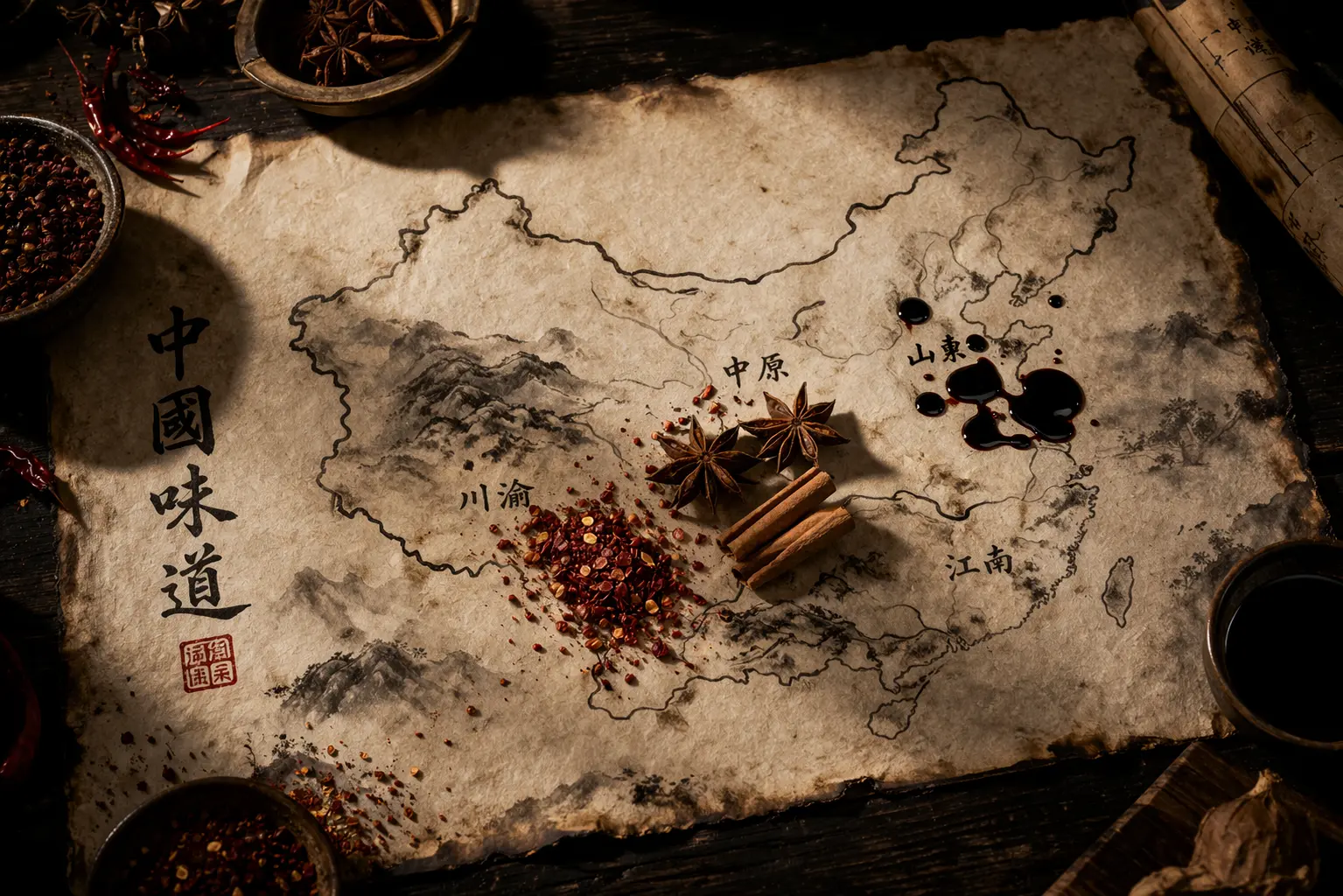
Sichuan's foggy basin created one of the world's boldest cuisines. The climate demands numbness, heat, and fermented depth — and once you eat it in Sichuan, the supermarket versions never taste the same.
Region
sichuan
Core Ingredients
5
Neighbor Profiles
2
Sichuan food is not just spicy. It's numbing, fermented, layered, and built on a flavor logic that makes complete sense once you've stood in the Sichuan basin in August and felt the humidity wrap around you like a wet blanket. The food is a survival mechanism. The climate is the reason. And until I ate Mapo Tofu at a street stall in Chengdu, I didn't understand how far the export versions had drifted from the real thing.
The single most important ingredient in Sichuan cooking is not the chili. It's doubanjiang. I've watched Western cooks load up their Mapo Tofu with extra dried chilies, chasing heat that they think is the hallmark of Sichuan food. The hallmark is the doubanjiang — fermented broad bean paste aged in clay urns for months to years, developing a funky, salty, slow-building complexity that you cannot replicate with fresh chilies, dried chilies, or chili oil. Heat is easy. Fermentation depth is the whole point.
The numbing is not optional. Sichuan pepper (花椒) produces a sensation called 麻 (má) — a 50 Hz electrical buzz on your tongue and lips that has no equivalent in any other world cuisine. I've served Sichuan food to friends who've never tried it, and their reaction follows a predictable arc: confusion ("Why does my mouth feel weird?"), alarm ("Is this an allergic reaction?"), delight ("Wait, I want more of this"), and finally addiction ("I need to buy Sichuan pepper immediately"). Without the numbing, Sichuan food is just spicy Chinese food. With it, it's a sensory category of its own.
The geography drives the flavor. Sichuan province is a giant basin ringed by mountains, trapping moisture and creating persistent fog and humidity — 80%+ for much of the year. In a pre-refrigeration world, fermentation was a preservation strategy. Doubanjiang, pickled vegetables, fermented black beans — these are not flavor experiments. They're adaptations to a climate where fresh food spoils quickly. The heat from chilies was understood in traditional Chinese medicine to "dry" the body, counteracting the dampness of the environment. What we now call "Sichuan cuisine" is a 2,000-year-old engineering response to a specific set of geographic constraints.
I visited Chengdu in 2023, partly to eat and partly to understand why the Sichuan food I was making in Hong Kong — with the same ingredients, the same recipes — never quite tasted like the restaurant versions I'd had growing up in mainland China. I ate at a street stall near the Wenshu Monastery that served exactly one dish: dan dan noodles. The stall had been operating for 30 years. The owner — a woman in her 60s with forearms like a tennis player's — worked a single wok over a jet burner that roared like a jet engine. She made my noodles in under 90 seconds. They cost 8 RMB (about $1.10 USD). They were the best noodles I had ever eaten.
What I realized, watching her work, was that she wasn't doing anything I couldn't do technique-wise. She fried doubanjiang in oil first — I did that. She added soy sauce and vinegar — I did that. She finished with a spoonful of chili oil and a handful of ground Sichuan pepper — I did that. The difference was not technique. The difference was ingredient quality. Her doubanjiang came from a producer in Pixian, aged three years, still slightly bubbling with residual fermentation. Her Sichuan pepper was harvested that season, still redolent with the citrusy-floral aroma of fresh sanshool. Her chili oil was made that morning. Every single ingredient was one order of magnitude better than what I could buy at the Wellcome in Hong Kong.
The lesson: Sichuan cooking is ingredient-driven, not technique-driven. You can learn the techniques in a weekend. You cannot shortcut the ingredient quality. A three-year-aged doubanjiang from Pixian is a different product than a six-month-aged doubanjiang from Lee Kum Kee. The recipes are the same. The results are not.
The Three Pillars of Sichuan Flavor
1. 麻辣 (má là) — Numbing-Heat. This is the characteristic that defines Sichuan cooking and has no equivalent in any other cuisine. The Sichuan pepper buzzes your lips and tongue — a physical vibration, not a flavor — while the dried chilies provide warmth in your throat. The combination creates a unique sensory layering where the numbing precedes the heat, intensifies it, and then outlasts it, leaving your mouth tingling for minutes after you've finished eating.
2. 鲜香 (xiān xiāng) — Umami-Aromatic Depth. Sichuan cooking layers umami through doubanjiang (fermented broad bean paste), light soy sauce (fermented soybean liquid), and fermented black beans. Aromatics — garlic, ginger, scallion — are used in quantities that would shock a Cantonese chef. The garlic in a Sichuan dish is not a background note. It's a foreground presence.
3. 复合味 (fùhé wèi) — Compound Flavor. Sichuan cooking never pursues a single flavor. Every dish balances at least three, and often five or six, taste dimensions simultaneously. Kung Pao Chicken is spicy + numbing + sweet + sour + savory + aromatic. Mapo Tofu is numbing + spicy + salty + umami + slightly sweet. The "fish-fragrant" flavor (鱼香) contains no fish at all — it's a compound of pickled chilies, ginger, garlic, sugar, and vinegar that was historically used to cook fish and now exists as its own flavor category. This is the most sophisticated dimension of Sichuan cooking and the hardest for home cooks to learn. It's not about adding more. It's about balancing.
The Three Essential Ingredients — and How to Source Them
Doubanjiang (郫县豆瓣酱): Buy Pixian doubanjiang specifically. The label should say 郫县豆瓣. If it doesn't specify the origin, it's a generic version. Lee Kum Kee makes a widely available version that's acceptable for learning. The upgrade path: order from the Mala Market or a Sichuan specialty importer. A 500g bag of three-year-aged Pixian doubanjiang costs about $8 USD and will transform your cooking more than any other single ingredient purchase. Store in the refrigerator after opening — it's fermented, salty, and essentially immortal.
Sichuan pepper (花椒): Buy vacuum-sealed. The compound responsible for the numbing — hydroxy-alpha-sanshool — is volatile and degrades on contact with air and light. A peppercorn from a bulk bin has probably lost 70-90% of its potency. Soeos brand on Amazon ($6 for a 4oz bag) uses nitrogen-flushed packaging that preserves the sanshool. Test freshness before use: one husk on your tongue should produce a tingle within 3 seconds. If it doesn't, the pepper is dead.
Chili oil (红油): You can make it yourself — it's easy and dramatically better than store-bought. Heat 1 cup of peanut oil to about 150°C. Pour over a mixture of 3 tablespoons crushed dried red chilies, 1 tablespoon ground Sichuan pepper, 1 star anise, and a small piece of cinnamon in a heatproof bowl. Let cool. Strain. Keeps for months in the refrigerator. The homemade version has a freshness and complexity that no jarred chili oil I've tried can match.
The Pixian Pilgrimage — What Happened When I Actually Went There
Pixian is a small county about 40km northwest of Chengdu, accessible by a 3-hour bus ride through increasingly rural Sichuan countryside. I went because I wanted to taste doubanjiang at its source, and because someone on a food forum had described it as "the single best food experience of my life, and I've eaten at Noma."
The town smelled like fermented beans — not in a bad way, but in the way that a bakery smells like bread or a winery smells like grapes. It was the ambient atmosphere of the place, a smell so pervasive that I stopped noticing it after about ten minutes, then noticed it again whenever I left a building and re-entered the street.
I found a small factory that had been operating since the 1950s. An old woman — the owner's mother, I think, though we communicated entirely through gestures and my terrible Mandarin — led me to a row of clay urns in a courtyard. Each urn was sealed with a clay cap and marked with a date in chalk. She opened one marked 2020. Three years of fermentation. She scooped out a spoonful with a long wooden paddle. The doubanjiang was dark red, almost rust-colored, with visible chunks of broad bean and chili. It was still slightly bubbling — residual fermentation, still active after 36 months. She handed me the spoon.
The taste unfolded in distinct phases. First: salt. A clean, sharp saltiness that hit the front of my tongue. Second: fermentation funk — the deep, savory, almost cheesy umami of aged broad beans. Third: a slow-building heat that started as a warmth and graduated to a steady burn over about 30 seconds. Fourth: an earthy finish that lasted for minutes, long after I'd swallowed. I had been cooking with Lee Kum Kee doubanjiang for two years. I had thought I understood doubanjiang. I had not.
I bought two bags directly from the factory — vacuum-sealed, 500g each, for 25 RMB (about $3.50 USD) each. They lasted me about eight months in the refrigerator. When they ran out, I went back to LKK, and the difference was immediately obvious — flatter, sweeter, less complex. The three-year-aged version had ruined me for the commercial product.
Common Mistakes
Using only chilies and skipping the numbing. Heat without numbness is just spicy food. It's not Sichuan. The numbing is the defining characteristic. Buy fresh Sichuan pepper. Use the tongue test. If your mouth isn't buzzing, you didn't make Sichuan food.
Not blooming the doubanjiang. Doubanjiang must be fried in oil before any other ingredients are added. This process — called 煸香 (blooming) — transforms the harsh, raw fermented notes into a deep, aromatic base. Raw doubanjiang added directly to a sauce tastes funky in a bad way. Fried doubanjiang in hot oil for 30-60 seconds turns the oil red, fills the kitchen with a savory aroma that's detectable from the next room, and creates the flavor foundation for the entire dish.
Using supermarket doubanjiang and expecting Pixian results. The commercial export versions are younger, sweeter, and designed for palates that aren't accustomed to fermented intensity. They work. They're fine. But they are not the same product as what's used in Sichuan. The gap between LKK doubanjiang and three-year-aged Pixian doubanjiang is roughly equivalent to the gap between supermarket balsamic vinegar and 25-year-aged traditional balsamic. Same category. Different product.
FAQ
Q: What's the difference between Sichuan and Hunan food? Sichuan numbs. Hunan burns. Sichuan uses Sichuan pepper for a complex, vibrating sensory experience. Hunan uses pure chili heat — fresh and pickled — for a direct, aggressive burn. Sichuan builds complexity through fermentation and layering. Hunan achieves depth through freshness and contrast. Both are hot. They're hot in completely different ways. And if you want the opposite end of the spectrum — restraint over heat, wild mountain ingredients over chili oil — start with Anhui cuisine.
Q: How many Sichuan dishes should I learn? Three: Mapo Tofu (tofu in spicy, numbing sauce), Kung Pao Chicken (chicken with peanuts and chilies), and Twice-Cooked Pork (pork belly boiled then wok-fried). These three teach you the fundamental techniques — blooming doubanjiang, balancing the 复合味 compound flavors, and controlling heat with meat that needs different treatments at different stages. Master these three and you can cook 80% of the Sichuan canon.
Q: Is Sichuan pepper actually a pepper? No. It's the dried husk of the prickly ash shrub (Zanthoxylum), a member of the citrus family. The "pepper" name is a colonial-era translation error that stuck. Sichuan pepper is more closely related to lemons than to black pepper. This is why it has a citrusy, floral aroma alongside the numbing sensation — it shares chemical compounds with citrus fruits.
理论基础 / The Science Behind It
Sichuan cuisine's food system rests on three pillars: doubanjiang (fermentation), Sichuan pepper (má chemistry), and layered flavor sequencing.
Sichuan's 24 flavor profiles represent one of the world's most sophisticated bodies of food domain knowledge.
Continue Exploring
Written by Mike Sang
Digital strategist, fermentation science enthusiast, and student of the Tao. Bridging growth engineering with ancient Chinese food wisdom.
Seasonal Context
Flavor changes with the season. Your cooking should too.
Missing Umami is part of The Way of Nature, a living system connecting food, timing, and seasonal practice.