Editorial Guide
The Geography of Chinese Flavor — Why Sichuan Numbs, Cantonese Whispers, and Hunan Burns
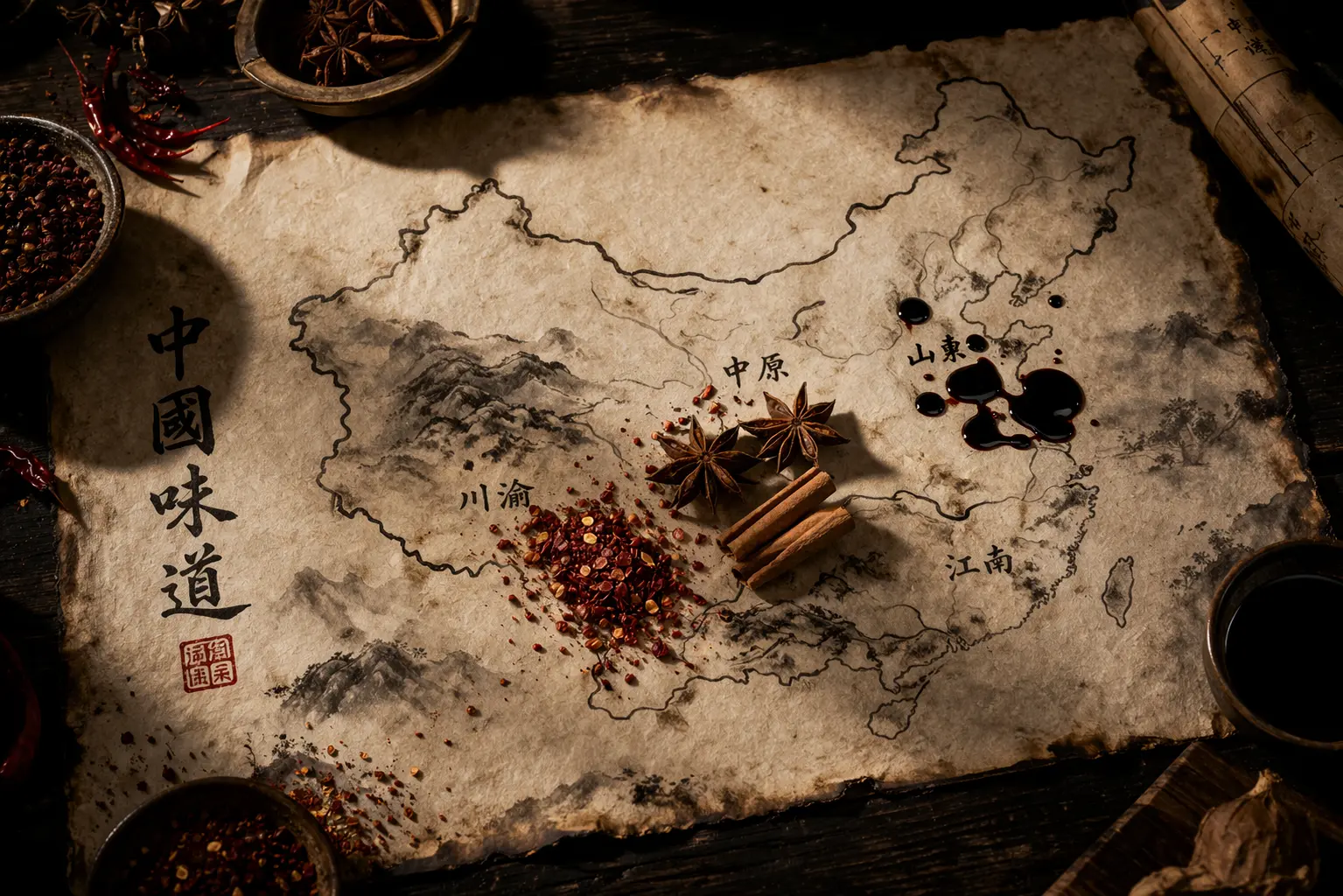
China's eight great cuisines are not random collections of recipes. They're direct responses to geography, climate, and history. Each region's food makes complete sense once you understand where it comes from.
Type
Editorial Guide
Linked Ingredients
Next Steps
Why Read This
This page is meant to connect history, flavor logic, and actionable kitchen judgment. It is not recipe filler. It is here to explain the mechanism behind the taste.
China is not a country with one cuisine. It's a continent-sized landmass with at least eight distinct culinary traditions, each a direct engineering response to its local geography, climate, and history. I didn't understand this until I traveled across four Chinese provinces in two weeks and tasted how dramatically the food changed every few hundred kilometers. The same ingredient — soybeans, say — becomes light soy sauce in the humid south, fermented black beans in the arid north, and doubanjiang in the foggy Sichuan basin. The same raw material. Completely different products. The difference is not in the recipes. It's in the climate.
The eight great cuisines are not equal in Western awareness. Sichuan and Cantonese are well-known internationally. Hunan has some recognition. The other five — Shandong, Jiangsu, Zhejiang, Fujian, Anhui — are essentially unknown outside of China. This is partly because their flavors are more subtle and less export-friendly (it's harder to sell "delicate" than "numbing"), and partly because the diaspora from those regions was smaller than from Guangdong and Fujian. But these lesser-known cuisines contain some of the most sophisticated cooking in China, and understanding them — even just reading about them — changes how you think about Chinese food.
The single most important concept for understanding Chinese regional cuisine is "the ingredient responds to the environment." Sichuan is humid, so food is fermented to preserve it and spiced to make you sweat (which cools the body). Cantonese food comes from a region with year-round access to fresh seafood and vegetables, so the cooking emphasizes freshness and minimal intervention. Northern Chinese food comes from a wheat-growing region with cold winters, so the cuisine is built on noodles, dumplings, and hearty braises rather than rice and stir-fries. The recipes are downstream from the geography.
The Eight Cuisines — A Practical Guide
Sichuan (川菜) — Numbing and Fermented. Geography: Humid basin surrounded by mountains. Hot summers, damp winters. Flavor logic: Fermentation is preservation. Chili heat causes sweating, which cools the body in humid conditions. Core ingredients: Doubanjiang (fermented broad bean paste), Sichuan pepper (numbing), dried chilies. Signature dishes: Mapo Tofu, Kung Pao Chicken, Twice-Cooked Pork, Dan Dan Noodles. The one thing to understand: Sichuan food is not about heat. It's about 麻辣 (má là) — the numbing-heat combination that exists nowhere else in world cuisine. The numbing is the point. The heat is the vehicle.
Cantonese (粤菜) — Fresh and Precise. Geography: Coastal southern China with year-round growing season. Access to fresh seafood, vegetables, and year-round warmth. Flavor logic: When ingredients are always fresh, the cooking should highlight them, not mask them. Core ingredients: Light soy sauce, oyster sauce, Shaoxing wine, ginger, scallion, sesame oil. Signature dishes: Dim sum, stir-fried gai lan, steamed fish, wonton noodle soup. The one thing to understand: Cantonese cooking is the hardest to master because it gives you nowhere to hide. Every flaw is exposed. The cooking is the seasoning.
Hunan (湘菜) — Direct and Aggressive. Geography: Subtropical monsoon climate. Similar humidity to Sichuan but different geographic response. Flavor logic: Pure chili heat, no numbing. Fresh chilies for brightness, pickled chilies for depth. Core ingredients: Fresh green and red chilies, pickled chilies (泡椒), doubanjiang, fermented black beans, smoked pork (腊肉). Signature dishes: Stir-fried pork with chilies (小炒肉), steamed fish head with chopped chilies (剁椒鱼头), Hunan crayfish (口味虾). The one thing to understand: Hunan food burns twice — fresh chili heat first, pickled chili heat second. It's the most aggressive heat in Chinese cooking. Chairman Mao ate it every day.
Shandong (鲁菜) — The Grandfather of Northern Cuisine. Geography: Northern coastal province with cold winters. Wheat-growing region with access to seafood. Flavor logic: Salty, savory, emphasis on broth and stock. The cuisine that influenced Beijing cooking and imperial court cuisine. Core ingredients: Light soy sauce, dark soy sauce, vinegar, scallions, garlic, wheat flour (for noodles and dumplings). Signature dishes: Braised sea cucumber, sweet and sour carp, Shandong-style dumplings (饺子), scallion pancakes. The one thing to understand: Shandong cuisine is the foundation of northern Chinese cooking. If you've eaten jiaozi (dumplings), sweet and sour anything, or Peking duck, you've eaten Shandong-influenced food. The cuisine prioritizes savory depth and textural contrast, especially the interplay between crispy and tender.
Jiangsu (苏菜) — Delicate and Refined. Geography: Fertile Yangtze River Delta. Mild climate, abundant freshwater fish, year-round vegetables. Flavor logic: Sweetness as a background note. Emphasis on knife skills (shapes matter) and texture (soft, tender, smooth). Core ingredients: Light soy sauce, sugar, rice vinegar, Shaoxing wine, freshwater fish, crab. Signature dishes: Sweet and sour Mandarin fish (松鼠桂鱼), lion's head meatballs (狮子头), braised pork belly (红烧肉 — the Jiangsu version is sweeter than other regions). The one thing to understand: Jiangsu cuisine is the most technically demanding in China. A chef's knife skills are judged more than their seasoning. The cuisine values shape and texture as much as flavor.
Zhejiang (浙菜) — Fresh and Elegant. Geography: Coastal province south of Shanghai. Abundant seafood, bamboo shoots, tea. Flavor logic: Light, fresh, slightly sweet. Minimal heavy seasoning. The ingredients should taste of themselves. Core ingredients: Fresh seafood, bamboo shoots, Shaoxing wine, Longjing tea, ham. Signature dishes: Dongpo pork (东坡肉), West Lake fish in vinegar sauce (西湖醋鱼), Longjing shrimp (龙井虾仁). The one thing to understand: Zhejiang cuisine is Cantonese cuisine's more delicate cousin. Where Cantonese uses oyster sauce and soy for finish, Zhejiang uses minimal seasoning and relies entirely on ingredient quality.
Fujian (闽菜) — Umami-Rich and Soup-Centered. Geography: Coastal southeastern province. Mountainous interior with limited arable land. Access to abundant seafood. Flavor logic: Umami-forward through seafood stocks, fermented fish sauce, and dried ingredients. Soup is the centerpiece of the meal. Core ingredients: Fish sauce (鱼露), dried seafood (shrimp, scallops), fermented red yeast rice (红糟), bamboo shoots. Signature dishes: Buddha Jumps Over the Wall (佛跳墙 — an elaborate soup with 30+ ingredients), Fujian-style fried rice, oyster omelette. The one thing to understand: Fujian cuisine is the most umami-dense of the eight traditions because of its emphasis on soup stocks, dried seafood, and fish sauce. Every dish is built on a foundation of long-simmered broth. The phrase "Buddha Jumps Over the Wall" comes from a legend that the aroma of this soup was so irresistible that a vegetarian monk jumped over the monastery wall to eat it.
Anhui (徽菜) — Rustic and Mountainous. Geography: Inland mountainous province. Limited arable land. Cold winters. Flavor logic: Preserved and cured ingredients. Wild herbs and foraged foods. Heavy on braising and stewing. Core ingredients: Cured ham, wild herbs, bamboo shoots, mushrooms, rock sugar. Signature dishes: Stinky mandarin fish (臭鳜鱼 — fish that's been fermented until it develops a strong aroma before cooking), braised turtle with ham, Anhui-style braised pork. The one thing to understand: Anhui cuisine uses more wild and foraged ingredients than any other Chinese regional cuisine. The mountainous terrain meant limited agriculture, so foraged herbs, mushrooms, and wild game became dietary staples. The stinky mandarin fish is the cuisine's most famous (and most divisive) dish. See the full Anhui Flavor Profile for the deeper story.
The Practical Takeaway
You don't need to master all eight cuisines. Most Chinese home cooks don't. They cook the food of their region, plus a few dishes from neighboring regions that have become nationally popular.
If you want to understand Chinese food, learn three cuisines: the one you live near (whatever that is), Sichuan (because its techniques are the most exportable and its ingredients are the most widely available), and Cantonese (because it teaches precision and restraint that apply to every other cuisine). From there, branch out.
Common Mistakes
Treating all Chinese food as interchangeable. A Sichuan recipe made with Cantonese ingredients will taste like neither. The regional differences are not subtle. They are fundamental.
Assuming "Chinese food" is one thing. There is no "Chinese food" in the way there is "Italian food" or "French food." There are eight distinct culinary traditions that share a national border. Learning Chinese food means learning which region's food you're cooking and respecting its specific ingredient and technique requirements.
Using the wrong soy sauce for the wrong region. Light soy is universal. Dark soy is primarily Cantonese and Shandong. Doubanjiang is Sichuan. Fish sauce is Fujian and Chaoshan. The soy product you use determines the region you're cooking.
FAQ
Q: Which cuisine should I learn first? Sichuan, if you like bold flavors. Cantonese, if you value precision. Hunan, if you love chili heat and want to explore a less-known tradition. Whichever you pick, commit to it for at least a month before branching out.
Q: Why aren't there more restaurants for the lesser-known cuisines? Diaspora patterns. The Chinese immigrants who opened restaurants in the West were predominantly from Guangdong (Cantonese food) and, later, Sichuan and Hunan. The cuisines of Shandong, Jiangsu, Zhejiang, Fujian, and Anhui had fewer emigrants and therefore fewer overseas restaurants. This is changing as China's international presence grows, but Cantonese and Sichuan remain the dominant representations of Chinese food abroad.
理论基础 / The Science Behind It
China's eight great cuisines are direct responses to geography, climate, and history — the food system operating at a regional scale.
Each regional cuisine represents a distinct body of food domain knowledge accumulated over centuries.
Continue Exploring
Written by Mike Sang
Digital strategist, fermentation science enthusiast, and student of the Tao. Bridging growth engineering with ancient Chinese food wisdom.
Seasonal Context
Flavor changes with the season. Your cooking should too.
Missing Umami is part of The Way of Nature, a living system connecting food, timing, and seasonal practice.