Editorial Guide
Velveting 101 — The Technique That Makes Chinese Restaurant Meat So Tender
Velveting is a 30-second pre-cooking step that transforms tough, lean meat into the silky, tender protein you get at restaurants. Here's exactly how it works and how to do it at home.
Type
Editorial Guide
Linked Ingredients
Next Steps
Why Read This
This page is meant to connect history, flavor logic, and actionable kitchen judgment. It is not recipe filler. It is here to explain the mechanism behind the taste.
Velveting is the single technique with the highest impact-to-effort ratio in Chinese cooking. It takes about five minutes of active work and transforms the texture of lean meat from "good home cooking" to "restaurant-quality." I've velveted every piece of chicken, pork, and beef I've stir-fried since I learned the technique, and the difference is so dramatic that I can't believe I ever stir-fried without it.
Velveting is not marinating. Marinating adds flavor to the surface of meat. Velveting creates a physical coating — a microscopically thin layer of egg white and cornstarch — that seals the surface, prevents moisture loss during cooking, and produces a silky, tender texture that persists even if you slightly overcook the meat. A marinated chicken breast will still be dry if you cook it 90 seconds too long. A velveted chicken breast will be tender even with a 60-second timing error. The coating buys you a margin of error that home cooks desperately need.
The science: egg white and cornstarch form a protein-starch matrix that denatures at a lower temperature than meat protein. When you velvet meat, this coating cooks first — at about 60-70°C — creating a sealed barrier before the meat inside has reached 50°C. The coating then acts as a moisture barrier: water inside the meat cannot escape, so the meat stays tender. The coating also creates a microscopically rough surface that browns more evenly than bare meat, improving the Maillard reaction when the velveted meat hits the wok. The same cornstarch logic, applied to sauces instead of meat, is the Starch Slurry Guide.
The Two Methods — Oil Velveting vs Water Velveting
Oil velveting (traditional): The velveted meat is passed through a pot of warm oil — 120-140°C, not hot enough to brown — for 30-60 seconds until the exterior turns opaque. The oil creates a richer flavor and a glossier texture than water velveting. This is the restaurant method. It requires about 2 cups of oil, which can be strained and reused. I do this about once a month, when I'm cooking multiple dishes and the oil investment makes sense.
Water velveting (home method): The velveted meat is passed through a pot of gently simmering water for 30-45 seconds until the exterior turns opaque. The water creates a slightly leaner, cleaner-tasting result than oil velveting. This is the method I use for 95% of my home cooking. It requires no special equipment, uses no additional oil, and produces results that are 90% as good as oil velveting. The water can be saved as a light stock for soup.
I tested both methods side by side in January 2025: two identical chicken breasts, velveted identically, one passed through oil and one through water, then stir-fried in identical woks with identical sauce. In a blind taste test, my wife correctly identified the oil-velveted chicken as "slightly richer," but said both versions were "clearly restaurant-quality." The water method wins on convenience. The oil method wins on richness. Both win dramatically over un-velveted chicken.
The Basic Velveting Protocol
For one chicken breast or equivalent amount of meat:
- Slice the meat against the grain into thin, uniform pieces — about 3-5mm thick.
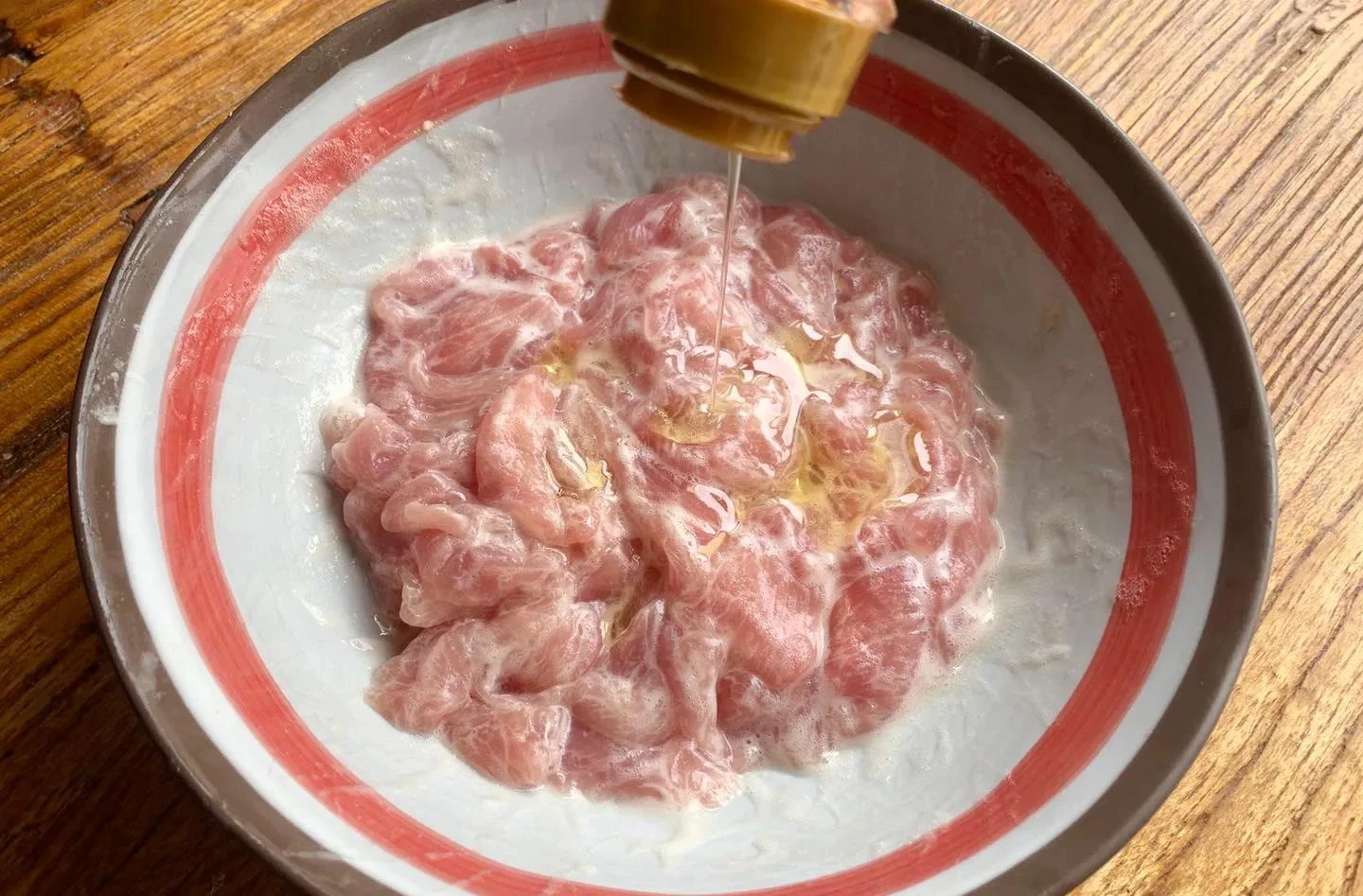
- Mix 1 egg white, 1 tablespoon cornstarch, 1 teaspoon Shaoxing wine, 1 teaspoon light soy sauce, and 1 teaspoon oil in a bowl.
- Add the meat. Massage the mixture into the meat with your hands for 30 seconds — the mechanical action helps the coating adhere.
- Let rest for 10-15 minutes at room temperature.
- Pass through simmering water (water method) or warm oil (oil method) for 30-45 seconds until opaque.
- Drain. Proceed with stir-frying.
The entire process, including rest time, takes about 20 minutes. The active work is maybe five minutes. The reward is meat that's tender, silky, and professional-quality every time. And for the chicken-specific playbook — slicing, the three-method face-off, and substitute rules — see the Velveting Chicken Guide.
FAQ
Q: Can I velvet without egg white? Yes — use 1 tablespoon cornstarch + 1 tablespoon oil + 1 teaspoon Shaoxing wine. The coating will be slightly thinner and less protective than with egg white, but still dramatically better than no velveting. I use the egg-white-free version when I'm cooking for someone with an egg allergy or when I'm too lazy to separate an egg.
Q: Can I velvet in advance? Yes, up to 4 hours. Velvet the meat, then cover and refrigerate. Pass through water or oil just before stir-frying. Don't pass through water/oil in advance — the coating will become gummy if it sits after cooking.
Q: Does velveting work for beef and pork? Yes — same protocol for all lean meats. Beef benefits slightly more from velveting than chicken because beef has a coarser protein structure that's more prone to drying out during high-heat cooking.
理论基础 / The Science Behind It
Velveting uses egg white and cornstarch to create a protein-starch matrix that denatures at ~60-70°C, sealing the meat surface before internal moisture escapes.
Continue Exploring
Written by Mike Sang
Digital strategist, fermentation science enthusiast, and student of the Tao. Bridging growth engineering with ancient Chinese food wisdom.
Seasonal Context
Flavor changes with the season. Your cooking should too.
Missing Umami is part of The Way of Nature, a living system connecting food, timing, and seasonal practice.