Editorial Guide
Wok Hei and the Thermodynamics of Stir-Fry — Why Heat Is an Ingredient
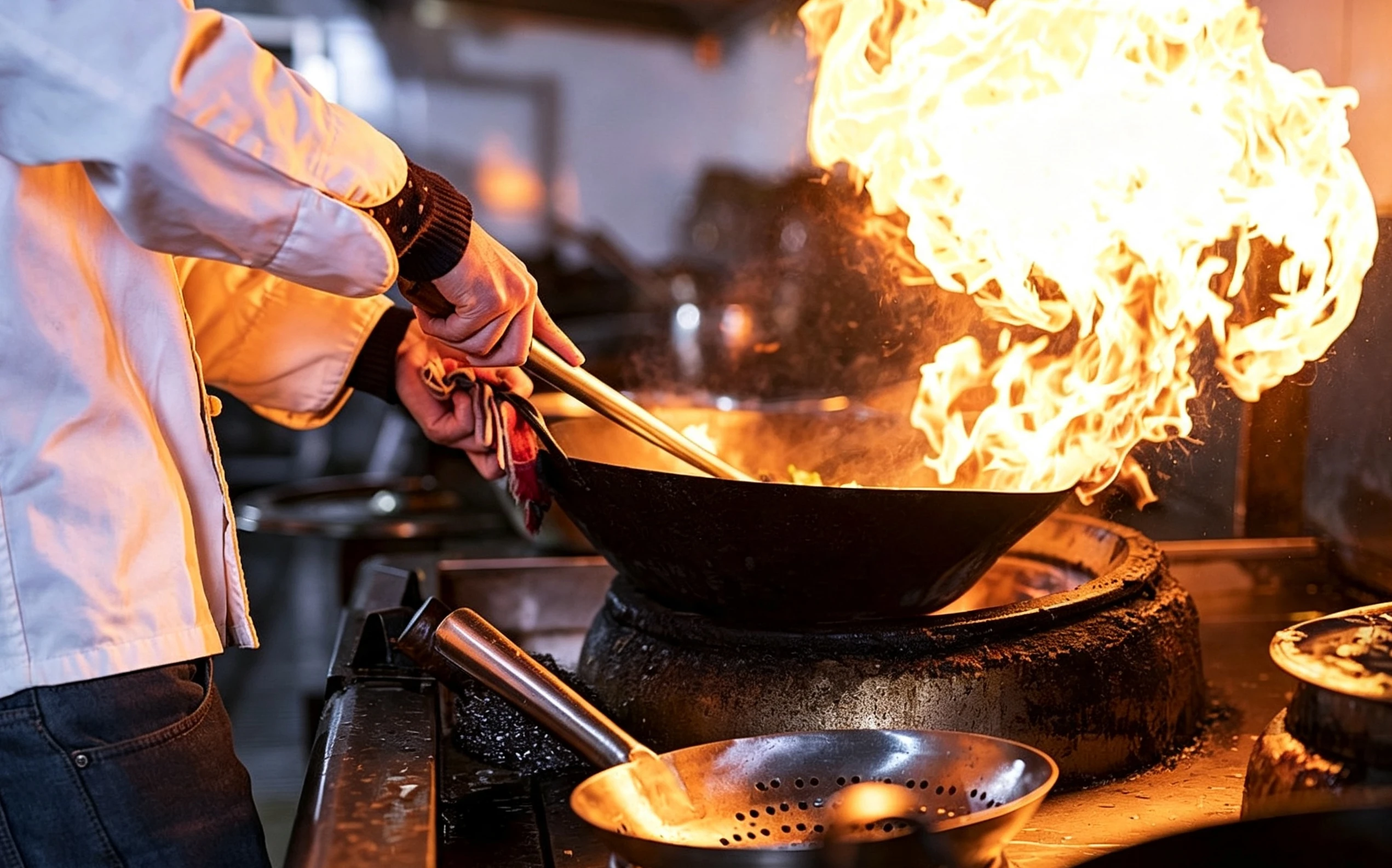
Wok hei is not a myth. It's a chemical event driven by temperature, oil vaporization, and flame contact. Here's the physics of what's actually happening when a professional chef tosses food through a jet of fire.
Type
Editorial Guide
Linked Ingredients
0
Next Steps
1
Why Read This
This page is meant to connect history, flavor logic, and actionable kitchen judgment. It is not recipe filler. It is here to explain the mechanism behind the taste.
Wok hei is a real, measurable physical phenomenon. It's not culinary mysticism. It's the product of three specific physical processes that happen simultaneously when a wok reaches above 350°C over a high-output gas burner:
Aerosolized oil ignition. When oil droplets are tossed above the wok by the chef's motion, they encounter the open flame and ignite — producing tiny, momentary bursts of fire that directly contact the food surface. This flame contact, lasting fractions of a second, creates hundreds of flavor compounds through high-temperature Maillard reactions and pyrolysis that would not form at the lower temperatures of the wok surface alone.
Radiant heat transfer from flame to food. The airborne food particles absorb intense infrared radiation from the burner flame, adding a second, simultaneous heating mechanism that operates independently of the wok surface. This is why wok hei can brown food on all sides simultaneously — the radiant heat heats from above while the wok surface heats from below.
Smoke condensation. The aerosolized oil and food particles that don't ignite instead condense back onto the food as microscopic droplets, depositing smoky flavor compounds — phenols, carbonyls, and other volatile organics — onto the surface of every ingredient. This is the "smoky" dimension of wok hei that's hardest to replicate without flame contact.
The three processes together create a flavor profile that's simultaneously seared (from the wok surface), charred (from the flame contact), and smoky (from the condensation). No single cooking method — broiling, searing, torching — can replicate all three simultaneously. This is why wok hei is unique to extremely high-output gas wok cooking.
The practical implications for a home cook: you need at minimum a carbon steel or cast iron pan that can reach 250°C+, a high-output burner (gas is strongly preferred), and small batch sizes that don't drop the pan temperature when food is added. If you're on induction or electric, you can achieve good searing — Maillard browning on the pan surface — but you cannot achieve true wok hei because the airborne flame contact and smoke condensation processes are absent. That doesn't mean your stir-fry is bad. It means it's a seared stir-fry, not a wok hei stir-fry. The difference is noticeable. It's also not the end of the world.
FAQ
Q: Can I use a kitchen torch to simulate wok hei? Yes, partially. A kitchen torch can provide the radiant heat and some of the smoke condensation that are missing from indoor cooking. Use it to torch the surface of the food during stir-frying — a brief pass over the top of the wok while tossing. It's not the same as 50,000 BTUs of flame, but it adds a detectable smoky char that brings your stir-fry closer to restaurant quality than any other home technique I've tested.
Q: What temperature does wok hei actually require? 350°C at the wok surface minimum. For comparison: water boils at 100°C, most oils smoke between 180-230°C, and a Maillard reaction becomes significant above about 140°C but accelerates dramatically above 200°C. The 350°C threshold is where the oil droplets become light enough to become aerosolized by the chef's tossing motion and reach the open flame. Below this temperature, the oil stays in the pan and wok hei cannot occur.
理论基础 / The Science Behind It
Wok hei is three simultaneous physical processes: aerosolized oil ignition, radiant heat transfer, and smoke condensation — all requiring 350°C+.
Continue Exploring
Written by Mike Sang
Digital strategist, fermentation science enthusiast, and student of the Tao. Bridging growth engineering with ancient Chinese food wisdom.
Seasonal Context
Flavor changes with the season. Your cooking should too.
Missing Umami is part of The Way of Nature, a living system connecting food, timing, and seasonal practice.