Umami Science
Why Restaurant Chinese Food Tastes Different — I Watched a Chengdu Chef for Four Hours and Finally Understood
You've got the right soy sauce. The right Shaoxing wine. You've followed the recipe to the letter. But it still doesn't taste like takeout. Here's the final 10% that Chinese restaurants know and recipes never tell you.
Topic
Flavor Science
Linked Ingredients
Related Reads
Working Rule
If a dish is properly salted but still tastes flat, you likely have a missing umami problem, not a seasoning problem. This page exists to help you see that difference clearly.
The gap between "good homemade Chinese food" and "restaurant Chinese food" is about 10%. It's not 50%. It's not a mystery that requires a CIA-level investigation. It's a specific set of techniques and ingredients that professional kitchens use automatically and home cooks have never been told about. I learned what they are in a single evening, watching a Chengdu chef work a wok for four hours.
Every Chinese restaurant kitchen I've been in has a container of MSG next to the salt. The chef isn't hiding it. She's not sneaking it into your food like a guilty secret. She's using it the way a French chef uses butter — as a foundation ingredient that makes everything else taste better. The MSG question is not "should I use it?" It's "why wouldn't I?" If your food doesn't taste as good as a restaurant's, the MSG gap is about 3% of the explanation. The other 7% is technique.
The most important technique you're missing is velveting. Almost every piece of meat in a Chinese restaurant — the chicken in your Kung Pao, the beef in your chow fun, the pork in your twice-cooked pork — has been velveted: marinated with egg white, cornstarch, and a small amount of oil, then briefly passed through hot oil or boiling water before it ever touches the wok. Velveting creates a microscopically thin coating around the meat that seals in moisture, prevents overcooking, and produces a silky, tender texture that you cannot achieve with a standard marinade. I learned this from the Chengdu chef on the third dish she made. "First step," she said, pointing at the bowl of velveted chicken. "Every time. No exceptions." For the full chicken protocol — slicing, coating ratios, and the method face-off — see the Velveting Chicken Guide.
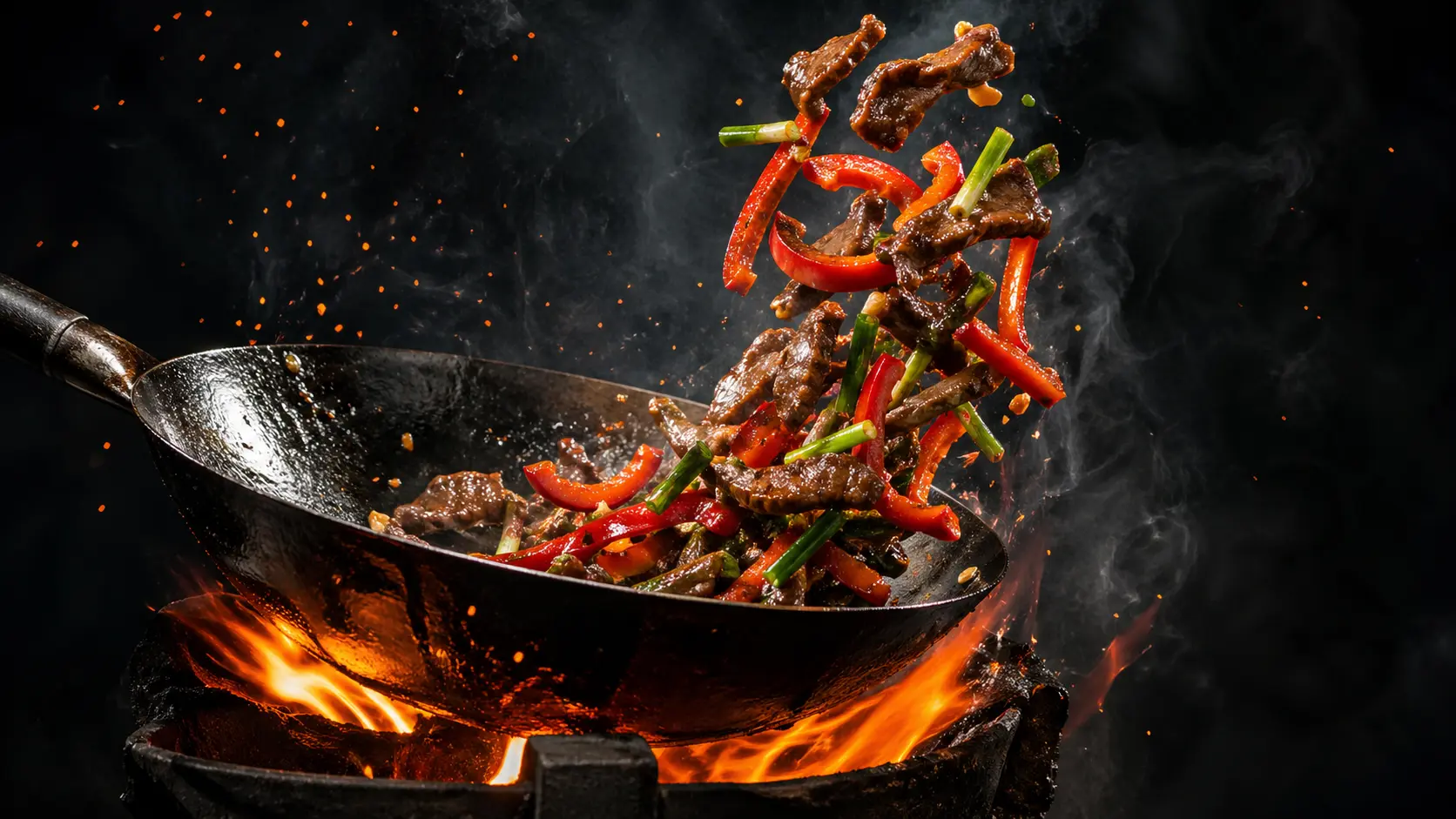
Restaurant woks run at 50,000+ BTUs. Your home burner runs at maybe 8,000. That's not a difference in degree. It's a difference in kind. The jet-engine roar of a professional wok burner creates heat that sears food in seconds rather than minutes, producing the smoky char and crisp-tender texture that defines restaurant stir-fries. You cannot replicate this at home. But you can compensate: preheat your wok longer (5+ minutes), cook in smaller batches (half what you think is reasonable), and never — under any circumstances — overcrowd the pan.
In 2023, I spent an evening in the kitchen of a small Sichuan restaurant in Chengdu. I had gone to eat, but the chef — a woman in her 40s who had been cooking professionally for 20 years — noticed me watching her work and, through a combination of my broken Mandarin and her broken English, invited me to stand in the corner and observe. I stayed for four hours. I took notes on my phone until the battery died, then switched to a paper napkin and a borrowed pen. That evening changed how I cook more than any cookbook, video, or blog post I've ever encountered.
The 9 Things She Did That Recipes Never Tell You
1. She velveted everything. Every piece of meat — chicken, pork, beef — was marinated with egg white, cornstarch, Shaoxing wine, and a splash of oil for at least 10 minutes before cooking. Then it was passed through a pot of gentle simmering water (not oil — she used water velveting for speed) until the exterior turned opaque, about 30-45 seconds. Only then did it go into the wok. The texture difference between velveted and un-velveted chicken is roughly the difference between restaurant chicken and the dry, stringy pieces you get at home. I now velvet every piece of meat I stir-fry. The extra 15 minutes of prep time is not optional.
2. She used more oil than any home cook would dare. Not deep-frying quantities. But a stir-fry for one person started with 2-3 tablespoons of oil — about triple what I was using at home. The oil is functional: it creates a thermal bridge between the wok surface and the food, prevents sticking, and carries flavor compounds from the aromatics into every ingredient. The finished dish was not greasy. The oil had done its work and stayed behind in the wok. The food that emerged was glossy, seared, and restaurant-quality.
3. Her aromatics went in at the last possible moment. I used to start every dish by frying garlic and ginger first. She didn't. She fried the protein first (removed it), then the vegetables (removed them), then — with the wok clean and the oil fresh — she added garlic and ginger and fried them for exactly 10-15 seconds before adding the sauce. The aromatics were still bright, sharp, and fragrant when the dish was served, instead of having been cooked into brown submission over 3-4 minutes of stir-frying.
4. Her sauce went into the wok alone, without food. I used to pour sauce over the food in the wok. She poured the sauce into the empty, screaming-hot wok, let it bubble and thicken for 15-20 seconds, then returned the food and tossed everything together for exactly two turns before serving. The sauce reduced and concentrated before it ever touched the food, creating a thicker, more intensely flavored coating.
5. She used chicken powder — basically MSG mixed with dehydrated chicken stock — in almost every dish. A teaspoon here, a pinch there. Never enough to taste. Always enough to make the dish taste "more complete." The powder contains glutamate (from the MSG) and inosinate (from the chicken), creating a two-way umami stack in a single spoonful. I now keep a jar of chicken powder next to my MSG and use it for the same purpose.
6. She finished dishes with a splash of hot oil at the end. After plating, she'd heat a tablespoon of oil until it was nearly smoking, then pour it over the top of the dish. The oil sizzled on contact, releasing a final burst of fragrance from the scallions and aromatics that had been placed on top as garnish. This is the "sizzling plate" effect, adapted for home service.
7. She never washed her wok with soap. Between dishes, she'd add a splash of water to the hot wok, scrub with a bamboo brush for 10 seconds, pour out the water, wipe with a cloth, and add fresh oil. The wok never left the heat. The seasoning layer was continuously maintained. The whole process took under 30 seconds.
8. She sharpened her cleaver at the start of every shift. 10 strokes on each side with a whetstone. No more. A sharp knife means clean cuts, even cooking, and better texture. Most home cooks haven't sharpened their knives in months. I'm guilty of this.
9. Her mise en place was obsessive. Every ingredient was prepped before the first dish was fired. Garlic minced, ginger julienned, scallions sliced, sauce mixed, meat velveted, vegetables cut. Nothing was chopped during service. When an order came in, she reached for bowls, not knives. The difference between "I'll chop the garlic while the oil heats" and "the garlic is already chopped" is about 30 seconds of active cooking time — and in a professional kitchen, that's the difference between perfect and overcooked.
The Order of Operations — Her Sequence vs Mine
Here is the sequence she used, written out in order, because I've never seen it documented this clearly in English:
- Velvet the meat (egg white + cornstarch + wine + oil, 10 min)
- Pass velveted meat through simmering water (30-45 sec, until opaque)
- Remove meat, drain
- Heat wok to maximum. Add oil. Wait for shimmer.
- Add velveted meat. Sear 30 seconds. Remove.
- Add fresh oil. Add vegetables. Sear 30-45 seconds. Remove.
- Add fresh oil. Add garlic, ginger, dried chilies, Sichuan pepper. Fry 10-15 seconds until fragrant.
- Pour pre-mixed sauce into empty wok. Let bubble and thicken for 15-20 seconds.
- Return meat and vegetables. Toss twice — no more.
- Kill heat. Add scallions. Add final drizzle of sesame oil or hot oil pour-over.
- Serve immediately.
My sequence before that evening:
- Heat wok. Add oil. Add garlic and ginger. Fry until brown (too long — they were burnt).
- Add raw meat. Stir continuously (too much movement — no sear).
- Add vegetables. They release water. Everything steams.
- Add sauce directly onto food. It doesn't thicken properly.
- Serve. Wonder why it tastes like home cooking and not a restaurant.
The difference is not one thing. It's nine things, done in the correct order, with the correct timing.
The Compensations — What You Can Do on a Home Stove
You don't have a 50,000 BTU burner. You don't have a dedicated velveting station. You don't have 20 years of professional experience. Here's what you can do:
Compensate for low heat with longer preheating. Preheat your wok for 5+ minutes on maximum heat. A drop of water should skitter across the surface and evaporate in under one second before you add oil.
Compensate for small batches with patience. Cook your protein in two or three rounds, never more than a single layer in the wok. This takes longer. The results are incomparably better.
Compensate for no velveting station with a pot of water. Water velveting is 90% as effective as oil velveting and requires no special equipment beyond a pot and a strainer. Bring water to a bare simmer. Add your velveted meat. Stir gently for 30-45 seconds. Drain. Proceed with stir-frying.
Compensate for no chicken powder with MSG + stock. A pinch of MSG and a splash of concentrated chicken stock (the kind that comes in a jar, not a carton) provides the same two-way umami effect as chicken powder.
Compensate for no wok brush with a stiff sponge and hot water, no soap. Scrub while the wok is still warm. Dry on the burner. Oil lightly. This maintains your seasoning and costs nothing.
FAQ
Q: What's the single biggest thing I can change to make my food taste more like a restaurant? Velvet your meat. It's the technique with the highest impact-to-effort ratio. An extra 15 minutes of prep transforms the texture of your stir-fries from "good home cooking" to "did I order takeout?"
Q: Is MSG really necessary? No single thing is necessary. But if you want restaurant-quality food, you need to understand and deploy the tools that restaurants use. MSG is one of those tools. It's not magic. It's just glutamate, the same molecule that makes soy sauce and Parmesan taste savory. Use it or don't. But know that the restaurant industry is using it, and that's part of why their food tastes the way it does.
Q: Can I velvet without egg white? Yes — use cornstarch and oil alone. The egg white adds protein that creates a slightly thicker, more protective coating, but a cornstarch + oil velveting is still dramatically better than no velveting at all. I use the cornstarch-only version on weeknights when I don't want to separate an egg for one chicken breast.
Q: Why does my wok smell like metal even after seasoning? You're washing it with soap, which strips the seasoning and exposes bare metal. Stop using soap. Hot water and a stiff brush are all you need for a properly seasoned wok. The heat of the next cooking session will kill any remaining bacteria.
理论基础 / The Science Behind It
The restaurant gap is 3% MSG and 7% technique — velveting, sequence, batch size, wok temperature. Every one is a food system variable.
The Chengdu chef's nine techniques represent accumulated food domain knowledge from thousands of hours of practice.
Continue Exploring
Written by Mike Sang
Digital strategist, fermentation science enthusiast, and student of the Tao. Bridging growth engineering with ancient Chinese food wisdom.
Seasonal Context
Flavor changes with the season. Your cooking should too.
Missing Umami is part of The Way of Nature, a living system connecting food, timing, and seasonal practice.