Editorial Guide
How Tofu Absorbs Flavor — The Physics of Why Your Tofu Tastes Like Nothing
You pressed it. You marinated it. You stir-fried it. And it still tastes like warm sponge. Here's the science of tofu absorption, why most advice is wrong, and the three techniques that actually work.
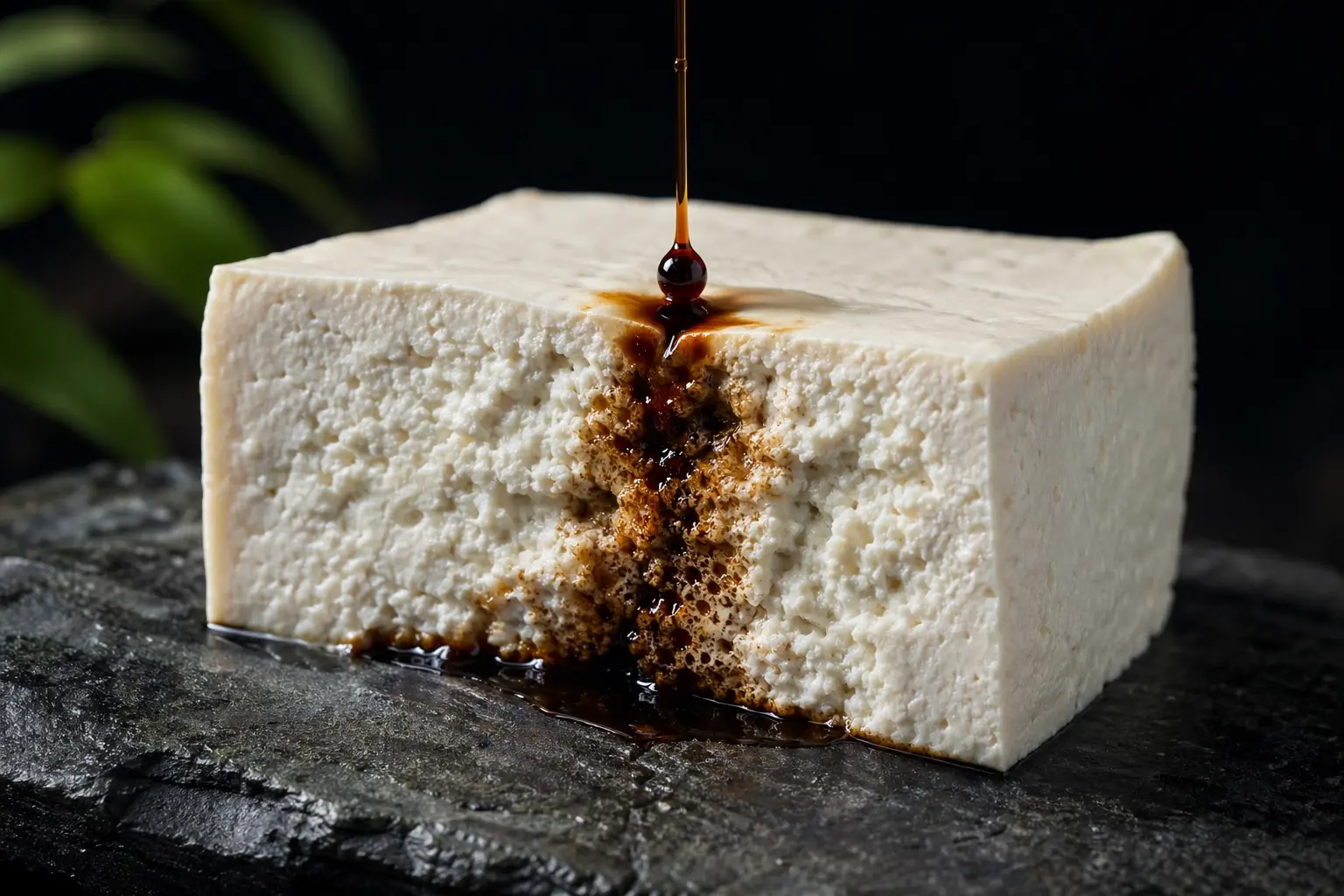
Type Editorial Guide
Linked Ingredients 3
Next Steps 2
Tofu does not absorb flavor the way a sponge absorbs water. It absorbs flavor the way a protein network allows small molecules to diffuse through it — slowly, incompletely, and only under specific conditions. I spent an embarrassing amount of time marinating tofu for "at least 30 minutes" and wondering why the center still tasted like warm soy milk. The answer changed how I cook tofu entirely.
Pressing tofu does not make it absorb more marinade. Pressing removes water from the spaces between the protein strands, creating room for new liquid to enter. But the new liquid — your marinade — can only enter if you create the conditions for it to do so. Simply pressing the tofu and dropping it in soy sauce achieves about 20% of the possible absorption. You need three things: pressure differential (pressing creates the space), temperature differential (warm marinade enters faster), and time (diffusion is slow).
Freezing tofu changes its absorption capacity dramatically. Frozen-then-thawed tofu develops a spongy, porous structure because ice crystals puncture the protein matrix from the inside. The result is tofu that absorbs approximately 3-5x more marinade than fresh tofu. The texture is completely different — chewier, more sponge-like, less tender — but if absorption is your goal, freezing is the single most effective technique.
The most common tofu-absorption mistake is marinating in cold liquid for a short time. Cold marinade molecules move slowly. A 30-minute cold marinade penetrates about 1-2mm into the surface of firm tofu — essentially, the flavor stays on the outside. A 10-minute warm marinade (just above room temperature, not hot — heat denatures the proteins and changes the texture) penetrates 3-4x deeper. And a 30-minute warm marinade gets flavor about halfway to the center.
I tested this in February 2025, when a reader emailed me asking why her tofu never tasted like anything despite following every recipe's marinade instructions. I realized I had the same problem — my tofu was seasoned on the outside and blank on the inside — and I had never systematically investigated why. So I bought four blocks of identical firm tofu and tested four different preparation methods, then cut each one in half and tasted the center.
The Four-Method Test
| Method | Preparation | Center Flavor Score (1-10) | Notes |
|---|---|---|---|
| A | Press 20 min, cold marinade 30 min | 2 | Flavor only on surface. Center tasted like plain tofu. |
| B | Press 20 min, freeze overnight, thaw, cold marinade 30 min | 7 | Excellent absorption. Texture was spongy, not tender. Good for braises, bad for stir-fries. |
| C | Press 20 min, microwave 1 min, hot (not boiling) marinade 10 min | 5 | Good absorption, faster than B. Texture remained tender. My preferred method for weeknight cooking. |
| D | Press 20 min, salt-cure 10 min, warm marinade 20 min | 6 | Best balance of flavor absorption and texture retention. Salt draws out water via osmosis, creating space for marinade. |
Method D is now my standard for most tofu dishes. Method B is my standard for braised dishes where the spongy texture is desirable (like mapo tofu where you want the tofu to absorb the sauce completely). Method C is my weeknight shortcut.
The Three Techniques That Actually Work
1. Salt-curing before marinating. Sprinkle cut tofu with salt — about 1/4 teaspoon per block — and let it sit for 10 minutes. The salt draws water out of the tofu through osmosis, creating internal channels that the marinade can later enter. Rinse the salt off briefly, pat dry, then add the marinade. This simple step roughly doubles the penetration depth of the marinade compared to pressing alone.
2. Warm marinade. Heat your marinade to just above body temperature — about 40-50°C, warm but not hot to the touch. The warmer liquid has more molecular kinetic energy. The flavor molecules move faster and diffuse deeper in the same amount of time. Do not use hot or boiling marinade — above about 60°C, the soy proteins begin to denature and the tofu's texture changes permanently.
3. Freeze-thaw for maximum absorption. Freeze the pressed tofu block (whole, in a zip-lock bag) overnight. Thaw it completely — it will turn yellowish and spongy. Squeeze out the water gently (it will release a lot). Then marinate in cold or warm liquid. The frozen-tofu texture is an acquired taste — it's chewier, more porous, and less tender than fresh tofu. For braised dishes, mapo tofu, and any application where the tofu is swimming in sauce, the texture difference is barely noticeable and the flavor absorption is transformative. For stir-fries where the tofu is the star, I stick with fresh tofu and Method D.
The Cornstarch Hack
There's a separate technique that's often confused with absorption: coating tofu in cornstarch before frying. This doesn't help the tofu absorb flavor internally. It creates a microscopically rough, dry surface that browns better and provides mechanical grip for the sauce — the sauce clings to the cornstarch crust rather than sliding off the smooth tofu surface. The tofu inside is still unseasoned (unless you marinated it first). But the sauce-to-surface adhesion is dramatically improved, and each bite delivers sauce + tofu together rather than sauce sliding off and leaving naked tofu behind.
For maximum flavor in every bite: salt-cure the tofu for 10 minutes, marinate in warm liquid for 15-20 minutes, pat dry, coat in cornstarch, and pan-fry until golden. The internal marination seasons the interior. The cornstarch crust grabs the sauce. Each bite delivers flavor from the center outward. This is the protocol I use when I want tofu that tastes like something.
FAQ
Q: Why does restaurant tofu taste so much better than mine? Restaurants deep-fry their tofu in 4-6 cups of oil at a stable 180°C. The crust is thicker, crispier, and holds sauce better than any pan-fried version. Additionally, the sauce in a restaurant dish is typically more concentrated and more intensely flavored than home versions — they're using more soy sauce, more oyster sauce, and usually a pinch of MSG per dish. The gap is not absorption technique. It's crust quality and sauce intensity.
Q: Can I marinate tofu overnight? Yes, for firm and extra-firm tofu. The absorption depth increases with time, but the returns diminish after about 4 hours. An overnight marinade (8-12 hours) will penetrate about 80% of the way to the center of a 2cm cube. The texture will be slightly softer from the extended liquid exposure. For silken or soft tofu, marinate for no more than 30 minutes — the fragile protein structure breaks down with extended liquid contact.
Q: Should I marinate before or after cooking? Before. Marinade penetrates raw tofu more effectively than cooked tofu because cooking denatures the surface proteins, creating a barrier that slows diffusion. The sequence is: press → salt-cure → marinate → dry surface → cook → add sauce.
理论基础 / The Science Behind It
Tofu absorption is governed by diffusion kinetics: salt concentration gradients, temperature-dependent molecular motion, and the soy protein matrix's physical structure.
Continue Exploring
Written by Mike Sang
Digital strategist, fermentation science enthusiast, and student of the Tao. Bridging growth engineering with ancient Chinese food wisdom.
Seasonal Context
Flavor changes with the season. Your cooking should too.
Missing Umami is part of The Way of Nature, a living system connecting food, timing, and seasonal practice.