Editorial Guide
Oil Temperature Guide — The Six Stages of Hot Oil and How to Recognize Each
Chinese recipes say things like 'heat oil until shimmering' and 'fry at 60% heat.' Here's what those cryptic phrases actually mean, translated into temperatures, visual cues, and the chopstick test.
Why Read This
This page is meant to connect history, flavor logic, and actionable kitchen judgment. It is not recipe filler. It is here to explain the mechanism behind the taste.
Chinese recipes are written in a code that assumes you already know how to read oil temperature. "Heat oil until shimmering." "Fry until golden at 60% heat." "Add aromatics when oil is just smoking." These instructions are specific, technical, and completely useless if you don't know what "shimmering" looks like or what "60% heat" means in degrees Celsius. I spent years guessing, burning garlic, steaming food that should have been searing, and wondering why my stir-fries never looked like the photos.
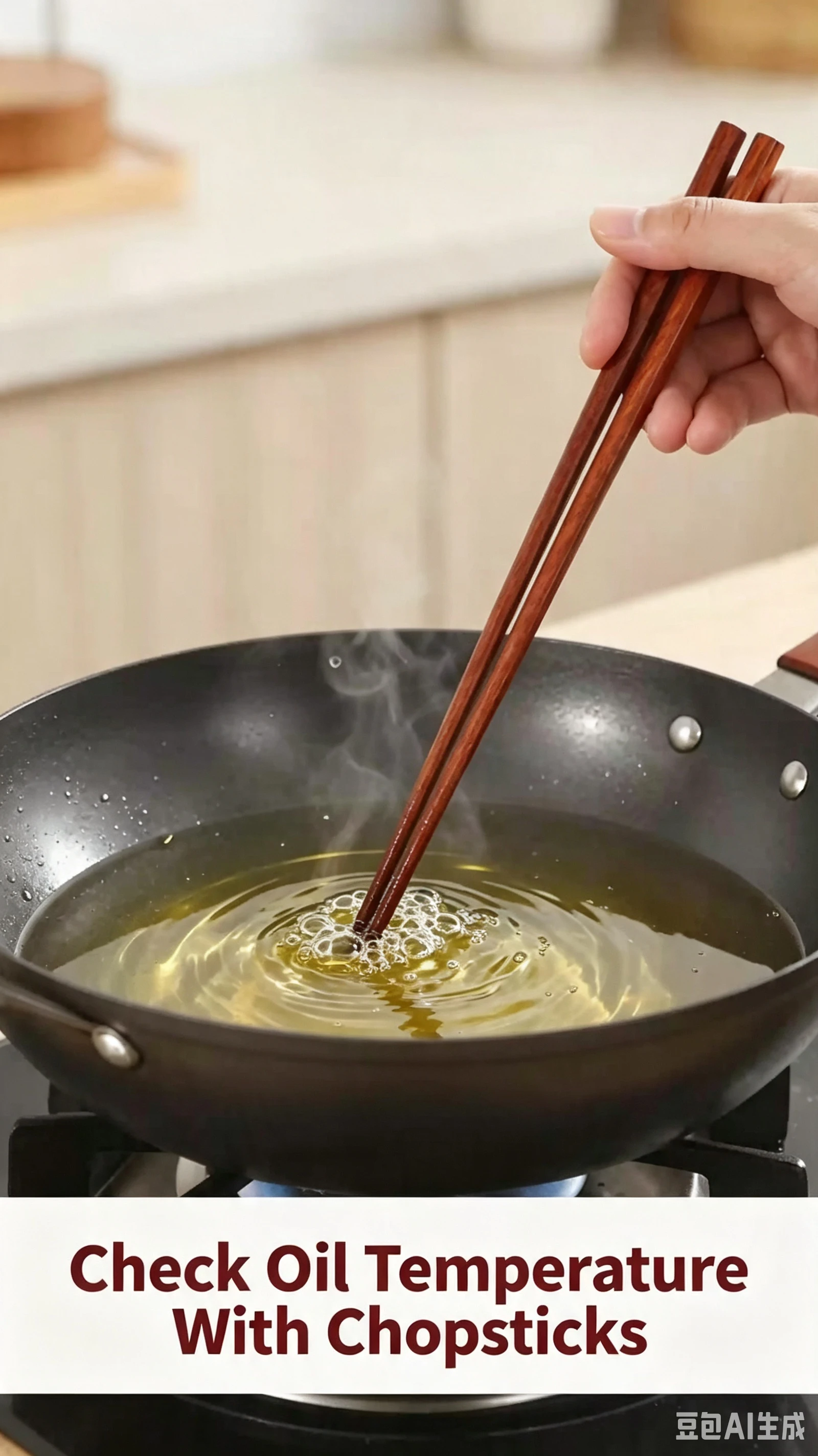
The chopstick test is the single most reliable way to gauge oil temperature. Stick the tip of a wooden chopstick (or a wooden spoon handle) into the oil. If nothing happens: the oil is below 120°C — too cold for frying. If tiny bubbles form slowly around the chopstick: 120-150°C — good for gentle frying. If vigorous bubbles stream upward from the chopstick: 150-180°C — standard frying temperature. If the oil around the chopstick immediately erupts into a crown of aggressive bubbles: 180°C+ — too hot for most applications, approaching the smoke point.
I learned the chopstick test from a street vendor in Sham Shui Po who was frying tofu at a dai pai dong. She didn't have a thermometer. She had a single wooden chopstick that she'd been using for years, worn smooth at the tip. She'd dip it into the oil, watch the bubbles, and either add the tofu or wait. Her tofu was perfectly fried every time. I asked her what temperature she was looking for. She shrugged and said, "Enough bubbles." That was her entire temperature control system. It was more accurate than my $80 HKD digital thermometer.
Key Takeaways
- The chopstick test is the most reliable way to gauge oil temperature: no bubbles = below 120°C, tiny slow bubbles = 120-150°C, vigorous streams = 150-180°C, aggressive crown = 180°C+
- Six distinct stages of hot oil: Cold (20-50°C), Warm (50-100°C), Low Fry (120-150°C), Medium Fry (150-180°C), High Fry (180-200°C), Smoking (200°C+)
- 50-60% heat (五六成热) = 150-180°C — the standard stir-frying zone where the Maillard reaction becomes significant for browning and flavor development
- Common mistakes: adding food to cold oil (makes it greasy), adding food to smoking oil (burns exterior), and adding wet food to hot oil (causes violent splatter)
- Always dry ingredients before adding to hot oil — water flash-boils on contact, causing dangerous oil eruptions
The Six Stages of Hot Oil
Stage 1: Cold (20-50°C) Visual: Oil is still, no movement. Chopstick test: Nothing happens. Use for: Nothing. Oil at this temperature is not doing anything useful.
Stage 2: Warm (50-100°C) Visual: Slight convection currents visible — gentle, slow movement in the oil. Chopstick test: No bubbles or very tiny, intermittent ones. Use for: Infusing aromatics (garlic, ginger) into oil at low temperature without browning them. Oil at this stage extracts flavor without cooking. Good for chili oil base.
Stage 3: Low Fry (120-150°C) Visual: Oil surface begins to shimmer — subtle, wavy distortions like heat rising from asphalt. Small bubbles may appear at the bottom of the pan. Chopstick test: Slow, steady stream of tiny bubbles. Use for: Frying delicate items (fish, egg, tofu) that need gentle, even heat. Also good for finishing fried items that are already cooked through but need browning. Chinese name: 三四成热 (30-40% heat). Velveted chicken passes through this stage — full method in the Velveting Chicken Guide.
Stage 4: Medium Fry (150-180°C) Visual: Oil surface is actively shimmering. Small wisps of steam may rise. Chopstick test: Vigorous streams of bubbles rising continuously. Use for: Standard frying — stir-frying, shallow frying, most home cooking. This is where the Maillard reaction becomes significant. Chinese name: 五六成热 (50-60% heat).
Stage 5: High Fry (180-200°C) Visual: Oil surface is shimmering intensely. Faint wisps of smoke may appear (the oil is approaching its smoke point). Chopstick test: Aggressive crown of bubbles immediately on contact. Use for: Quick searing — adding aromatics for 10-15 seconds, flash-frying, creating initial browning that will be finished at a lower temperature. Do not leave food at this temperature for more than 30 seconds without reducing heat. Chinese name: 七八成热 (70-80% heat).
Stage 6: Smoking (200°C+) Visual: Visible smoke rising from the oil surface. The oil is degrading. Chopstick test: Immediate, violent bubbling and the chopstick may scorch. Use for: Nothing — the oil is burning. Remove from heat, let cool, and start with fresh oil. Burnt oil has an acrid, bitter flavor that will taint everything cooked in it.
Oil Temperature Stages Reference Table
| Stage | Temperature | Chopstick Test | Best For | Chinese Name | Source |
|---|---|---|---|---|---|
| Cold | 20-50°C | No bubbles | Nothing useful | — | — |
| Warm | 50-100°C | Tiny/intermittent bubbles | Infusing aromatics, chili oil base | — | — |
| Low Fry | 120-150°C | Slow steady tiny bubbles | Delicate items (fish, egg, tofu) | 三四成热 (30-40%) | Wikipedia — Frying |
| Medium Fry | 150-180°C | Vigorous continuous bubbles | Standard stir-frying, shallow frying | 五六成热 (50-60%) | Wikipedia — Maillard reaction |
| High Fry | 180-200°C | Aggressive crown of bubbles | Quick searing (10-15 seconds) | 七八成热 (70-80%) | Wikipedia — Smoke point |
| Smoking | 200°C+ | Violent bubbling, chopstick scorches | Nothing — oil is burning | — | Wikipedia — Smoke point |
Smoke Point by Oil Type
Choosing the right oil for each cooking stage matters because oils degrade at different temperatures. Here are the smoke points of common oils used in Chinese cooking:
| Oil Type | Smoke Point | Best Cooking Stages | Notes |
|---|---|---|---|
| Refined peanut oil | ~230°C (446°F) | All stages (Medium Fry ideal) | Standard for Chinese stir-frying |
| Avocado oil | ~271°C (520°F) | All stages including High Fry | Neutral flavor, very high heat |
| Vegetable oil | ~204°C (400°F) | Warm to Medium Fry | Good all-purpose, lower smoke limit |
| Canola oil | ~204°C (400°F) | Warm to Medium Fry | Affordable neutral option |
| Sesame oil (refined) | ~210°C (410°F) | Warm to Medium Fry | Use toasted sesame oil only for finishing |
| Unrefined olive oil | ~190-207°C (374-405°F) | Warm to Low Fry | Not ideal for high-heat stir-frying |
Always match your oil's smoke point to your target cooking temperature. For standard stir-frying at 150-180°C (Medium Fry), any oil with a smoke point above 200°C works well. Peanut oil is the default for a reason — it handles the full range of Chinese cooking temperatures without degrading.
The Three Most Common Oil Temperature Mistakes
Adding food to cold oil. The food absorbs oil instead of being seared by it. Your stir-fry will be greasy and pale. Wait until the oil shimmers before adding anything.
Adding food to smoking oil. The exterior burns before the interior cooks. Burnt oil flavor permeates everything. If the oil is smoking, it's too hot. Remove from heat, let cool for 2 minutes, reduce the burner setting, and try again.
Adding wet food to hot oil. Water and hot oil do not mix peacefully. The water flash-boils on contact, creating an eruption of hot oil droplets that will burn your hands and arms. Dry your ingredients with paper towels before they touch the oil.
The Thermometer Reality
I own a digital instant-read thermometer. I use it about twice a year — usually when deep-frying, where temperature precision genuinely matters (too cool and the food absorbs oil, too hot and the exterior burns before the interior cooks). For everyday stir-frying, I use the chopstick test. It's faster, doesn't require batteries, and has never failed me. The chopstick has been making perfect fried tofu for longer than digital thermometers have existed.
Recommended Temperatures for Common Dishes
Different dishes need different oil stages. Here's a quick reference for when to use each temperature zone:
| Dish | Recommended Stage | Temperature | Why This Stage |
|---|---|---|---|
| Stir-fried leafy greens | Medium Fry | 150-180°C | Quick sear, retains crunch |
| Deep-fried spring rolls | Medium Fry | 150-180°C | Even cooking through the wrapper |
| Kung Pao chicken | High Fry (sear) → Medium Fry (finish) | 180-200°C → 150-180°C | Sear meat, then cook through |
| Scrambled eggs | Low Fry | 120-150°C | Gentle heat for creamy texture |
| Chili oil infusion | Warm | 50-100°C | Extract aromatics without burning |
| Pan-fried fish fillet | Low Fry | 120-150°C | Gentle browning, prevents burning |
| Tofu (deep-fried) | Low Fry | 120-150°C | Golden exterior, soft interior |
If you're learning one temperature to start, focus on Medium Fry (150-180°C). It covers the majority of stir-frying and shallow-frying. Add the others as you build confidence with the chopstick test.
Frequently Asked Questions
Q: What is the Maillard reaction and why does it matter for frying? A: The Maillard reaction is a chemical reaction between amino acids and reducing sugars that creates browning and complex flavor in seared foods. It begins around 140-165°C (285-329°F), which falls within the Medium Fry stage (150-180°C). This is the temperature zone where stir-fried foods develop their characteristic savory depth (Wikipedia — Maillard reaction).
Q: What's the smoke point of common cooking oils used in Chinese cooking? A: Refined peanut oil (standard for Chinese stir-frying) has a smoke point of ~230°C (446°F), suitable for all cooking stages. Other oils: avocado oil ~271°C, vegetable oil ~204°C, olive oil ~190-207°C. Always choose an oil with a smoke point above your target cooking temperature (Wikipedia — Smoke point).
Q: Can I reuse frying oil? A: Yes, with care. Strain through a fine-mesh sieve to remove food particles. Oil used below 180°C without smoking can be reused 2-3 times. If the oil reached its smoke point or has an acrid smell, discard it — degraded oil has a lower smoke point and imparts off-flavors (Wikipedia — Cooking oil).
Q: Why does oil temperature matter more for stir-frying than Western cooking? A: Chinese stir-frying relies on high heat and short cooking times (typically 30-60 seconds). Getting the temperature right determines whether ingredients sear properly, absorb excess oil, or burn. Temperature precision is critical when the cooking window is measured in seconds rather than minutes.
References: Wikipedia — Frying; Wikipedia — Maillard reaction; Wikipedia — Smoke point; Wikipedia — Cooking oil.
理论基础 / The Science Behind It
The six stages of hot oil correspond to specific chemical events: Maillard reaction thresholds, starch gelatinization points, and smoke points.
Continue Exploring
Written by Mike Sang
Digital strategist, fermentation science enthusiast, and student of the Tao. Bridging growth engineering with ancient Chinese food wisdom.
Seasonal Context
Flavor changes with the season. Your cooking should too.
Missing Umami is part of The Way of Nature, a living system connecting food, timing, and seasonal practice.