Editorial Guide
Dumpling Filling: The Four Layers That Actually Matter
Most dumpling filling advice is a list of things to add. It is also wrong. Salt, water, umami and aroma are four separate jobs, and the order you build them decides whether the filling works.
Type Editorial Guide
Linked Ingredients 4
Next Steps 2
There is a standard piece of dumpling filling advice that goes: add scallions, add ginger, add a spoon of soy sauce, add a dash of sesame oil, add Sichuan pepper, and your filling will taste good. I have read this advice in eleven places. I have made filling this way for a decade. And it produces a filling that tastes like a list of ingredients rather than like a dumpling. The problem is not that any of those additions are wrong. The problem is that they are doing four completely different jobs, and they are being added at the same time, in an order that was never specified.
The fix is not a better list. It is a sequence. Salt builds the foundation. Water hydrates and locks. Umami adds depth. Aromatics and fat carry the aroma and seal everything. Each layer has its own mechanism, and each one only works if the layers beneath it are already in place. Get the order wrong and no quantity of extra seasoning rescues it — the most common dumpling filling failure is not "not enough flavor," it is "too much flavor, in a structure that cannot hold it."
Key Takeaways
- Salt goes in first and alone, before any water. It seasons and it begins extracting protein. Two minutes of work, no shortcuts.
- Water goes in stages, in one direction, stirred until each addition disappears. This is the step that produces juice, and it is the step most people skip.
- Umami is a stack, not a single sauce. Soy alone is a note. Soy plus oyster sauce plus mushroom water is a foundation.
- Aromatics and oil go in last. Aromatics are fat-soluble, so they cannot deliver aroma through water — and a film of oil on the surface is what stops moisture escaping during cooking.
- Vegetables get folded in dead last, after the meat has taken all the water it can hold.
This is the same underlying problem as velveting chicken: a technique that sounds like one move is actually a choice between two different mechanisms, and you have to know which one you are performing.
The Four-Layer Flavor Architecture
Every good dumpling filling — jiaozi, gyoza, potstickers, whatever shape your regional tradition prefers — is built from the same four layers. The names are less important than the order.
Layer 1: Salt — the foundation
Salt is usually described as seasoning. That is half of what it does, and the half that matters less.
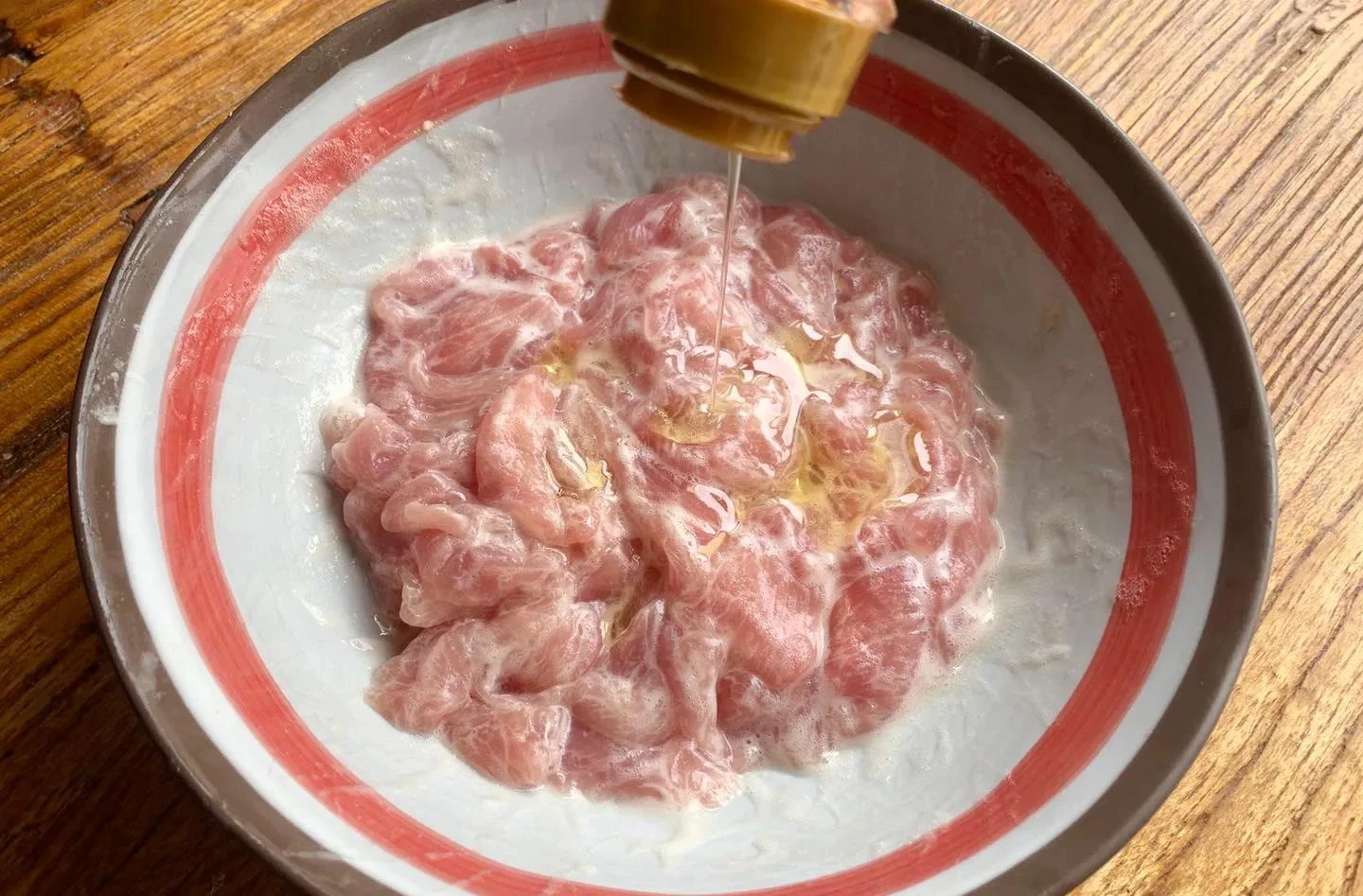
When you work salt into ground pork for a couple of minutes before adding anything else, two things happen. The pork tastes seasoned, obviously. And the salt begins to denature the surface proteins — the same proteins that make the meat hold together. The mixture goes tacky, turns slightly pale, and starts behaving less like loose mince and more like a paste.
That tackiness is the whole point. It is the first structural change in the filling, and it is what makes everything you add afterwards stay inside the meat instead of sliding out into the pan.
Roughly 1.2% of the meat's weight is a good starting point. For 500 grams of pork, that is about 6 grams. Work it in for two full minutes with nothing else present. Two minutes is not a figure of speech — the change in texture is not obvious until it happens, and it takes about that long.
Layer 2: Water — the hydration
Water is where the juice comes from. Not from fat, not from stock, not from the vegetables. From water beaten into meat.
Ground pork can hold a surprising amount of water, but only if you give it the structure to hold it. Add all the water at once and you get a soupy, loose filling that leaks into the pan and steams the wrapper instead of cooking the filling. Add it in stages and stir, and the muscle proteins extracted during salting form a network that traps the water rather than letting it pool.
The technique has a name in Chinese kitchens: 打上劲, "beating it to springy." You are looking for a change in the paste — it should start to pull together, become slightly gluey and springy, and stop feeling like raw mince. Some cooks call it "the meat grabs the bowl."
Cold water, three additions, one direction of stirring, each stirred until it has completely disappeared before the next goes in. Two minutes per addition. This is the highest-ceiling technique in the whole filling and the most demanding one. Bowl 4 in my test below is where that shows up in numbers.
A note on mechanism, because this is commonly stated wrong. The water is locked in by the developed protein network and by starch — not by oil. Oil does not seal moisture inside the meat. What a film of oil does is reduce moisture loss from the surface during cooking, which is a real and separate effect. Layer 2 and Layer 4 are different mechanisms and they should not be conflated, because that conflation is exactly how people end up adding oil early, thinking they have solved the dryness, and discovering the filling is now greasy and still dry inside.
Layer 3: Umami — the stack
Doubanjiang and the other fermented bean pastes do several jobs at once, which is why they are so central to Sichuan cooking and why understanding what umami actually is changes how you season.
For a filling that does not use doubanjiang — Northern style, or simply a preference — you need to build the savory depth from soy and friends. Here is the part most advice gets wrong: one strong sauce is not enough.
Light soy sauce alone raises savoriness and leaves the filling thin. It is a single note in a chord. The Umami Calculator is useful here because it makes the reasoning visible: soy contributes glutamate, oyster sauce contributes glutamate plus nucleotides, mushroom-soaking water contributes glutamate from a different source, and a small amount of sugar suppresses bitterness so the salt reads as savoriness rather than harshness.
Stacked, those sources give you depth that no single jar can. Soy sauce also brings sugar you may not want, so reduce other sweetness in the recipe when you add it. And note the limit of this layer: umami buys richness, not juice. If your filling is dry, more soy makes it saltier, not wetter.
Layer 4: Aroma and Fat — the cap
Scallion-ginger oil — 料油, liào yóu, the infused oil skimmed off the top when you fry aromatics — closes the filling.
Two jobs, two mechanisms. First, aroma: the volatile aromatic compounds in scallion and ginger are fat-soluble. Water cannot carry them, which is why adding scallion and ginger to a filling and expecting a fragrant result mostly produces a raw green note rather than a cooked aroma. Frying them first converts that into something that survives the boil.
Second, a film of oil on the surface of the filling reduces moisture loss during cooking. This is a surface effect, not a structural one — it protects what Layer 2 built rather than substituting for it.
White pepper goes in at this layer too, not the first. It is the most useful thing you can add against meaty off-notes, but it is harsh when raw and rounds out properly once the filling is cooked. Powdered white pepper, not ground — ground pepper reads as gritty and as a different spice entirely.
Store-bought sesame oil is a finishing aromatic, not a cooking fat. A few drops at the end, never more, because heat destroys the character you are buying it for.
And fold the vegetables in last. Napa cabbage, chives, celery, whatever your recipe calls for — salted to draw out water, squeezed genuinely dry, and folded in after the meat has already taken all the water it can hold. Skip the salting and squeezing and your filling leaks. Skip folding them in last and they release their water straight back into the meat after all that work.
The Eight-Step Method
The layers above, assembled. This is the version to cook from.
- Salt the meat. About 1.2% of the meat weight. Work it in, alone, for two full minutes until tacky and slightly pale.
- Add cold water in stages. Three additions of roughly a third of your total water. One direction of stirring. Each addition stirred until completely absorbed before the next.
- Stop when it grabs. The paste should pull together and feel springy. This is the texture checkpoint. Do not skip it because it looks like nothing is happening.
- Stack the umami. Light soy sauce, oyster sauce, a small pinch of sugar, mushroom-soaking water. Fold in.
- Kill the meaty off-notes. White pepper. Raw garlic if the recipe calls for it, in small quantity.
- Blend in the aromatic oil. The scallion-ginger oil, beaten in last, after everything else is already in.
- Fold the vegetables in dead last. Salted, squeezed dry, added at the very end.
- Rest before wrapping. Fifteen minutes in the fridge. The filling firms up enough to wrap cleanly, and the flavors stop fighting each other.
If you only change one thing, change step 2. It is the difference between a filling that leaks and a filling that fills the bite.
My Six-Bowl Test
I am running this properly rather than asserting results, so this section is the protocol and the scoring rubric — not the outcome.
The reason matters. This site does not publish numbers it has not measured, and a six-bowl comparison table with invented scores is worse than no table at all: it looks exactly like real data, and it would quietly discredit the parts of this page that are honest. So here is the design, and I will publish the measured version once the test is done.
The setup. 500 grams of ground pork at thirty percent fat, split six ways. Every bowl receives the same napa cabbage — 250 grams, salted ten minutes then squeezed dry — one egg, a tablespoon of grated ginger, two scallions, 100 milliliters of cold water, and 6 grams of fine salt. Same knife, same bowl, same one-direction stir. Each bowl's entire job is to change exactly one thing.
| Bowl | What changed |
|---|---|
| 1 — Control (dump and stir) | Everything in at once, single pour of water, thirty seconds of mixing, no oil |
| 2 — Soy sauce only | Salt swapped for one tablespoon of light soy sauce |
| 3 — Salt first | Salt worked into the pork for two full minutes before anything else |
| 4 — Water in stages | The 100 ml added in three additions, one direction, until absorbed |
| 5 — Umami stack | Soy sauce, two teaspoons of oyster sauce, sugar, mushroom-soaking water |
| 6 — Aromatic oil seal | Two tablespoons of scallion-ginger oil, beaten in last |
Four dumplings per bowl, wrapped blind, scored blind by two people on five dimensions at one to ten.
| Dimension | 3 looks like | 6 looks like | 9 looks like |
|---|---|---|---|
| Juiciness | Dry, crumbly | Moist | First bite releases broth |
| Aroma | Flat, raw-meaty | Clearly scallion and ginger | Aroma arrives before the taste |
| Savoriness | Just salty | Clear meat and sauce savoriness | Layered, wants a second bite |
| Cohesion | Falls apart, leaks water | Holds shape | Springs, holds together in the bite |
| Ease | Fiddly, easy to fail | Manageable | Dump and stir, no technique |
What I expect the test to show — and I am flagging this as a hypothesis, not a finding — is that no bowl wins on a single axis. Bowl 4 should top juiciness and demand the most work. Bowl 5 should top savoriness and do nothing for juice. Bowl 6 should top aroma and total, without winning any individual dimension. And the control should score well on ease, which is precisely the problem: it asks nothing of you and delivers nothing extra.
If that pattern is what comes back, the conclusion is not "oil is better." It is that each layer fixes a different failure, and the failures are not interchangeable. Dry and crumbly cannot be fixed with more soy. Juicy and dull cannot be fixed with more water. Knowing which failure you have is the whole skill.
When the test is done I will replace this table with the measured numbers and update the date. Until then, treat the table above as a design, not as a result.
If You Are Missing an Ingredient
The Substitution Calculator prices a swap in flavor fidelity rather than volume. Building the shelf from nothing, the Chinese Pantry Starter Kit covers the first bottles that unlock the most dishes.
FAQ
Q: Why does my dumpling filling leak out when I cook it? Almost always water handling, not seasoning. Either the water went in all at once instead of in stages, or the salt was not worked in long enough to develop the tacky structure that traps it, or the vegetables were added without being squeezed dry. Add oil earlier in the process and it will not fix this — oil reduces surface moisture loss, it does not trap water inside the meat.
Q: Should the vegetables go in before or after the meat? After, always last. Salt the vegetables first to draw out their water, squeeze them genuinely dry, then fold them in once the meat has already absorbed everything it can hold. Adding them earlier means their water gets counted twice.
Q: Can I make the filling ahead? Yes, and it is better for it. Mix everything except the aromatic oil, refrigerate for at least an hour, and add the infused oil just before wrapping. It firms up for easier wrapping and the flavors stop competing. Keep it cold and use it within a day.
Q: Do I have to use a binder like egg or starch? No. Neither is structurally required — the springiness in step 3 comes from the meat proteins, not from egg. Egg and starch are insurance: egg adds richness and binds, starch adds body and absorbs free water. Helpful, but they are not what makes a filling work.
Q: Is scallion-ginger oil essential or can I use plain oil? Plain oil works, and you will get aroma from the scallion and ginger themselves. What you lose is the concentrated flavor of the aromatic compounds that were fried into the oil. If you have twenty minutes to spare, make the oil and save it: it is the single highest-leverage step in this whole method.
Continue Exploring
Written by Mike Sang
Digital strategist, fermentation science enthusiast, and student of the Tao. Bridging growth engineering with ancient Chinese food wisdom.
Seasonal Context
Flavor changes with the season. Your cooking should too.
Missing Umami is part of The Way of Nature, a living system connecting food, timing, and seasonal practice.