Editorial Guide
The Velveting Chicken Guide: Technique, Steps & Substitutes
Baking soda vs egg white & cornstarch — I tested all three on identical chicken. How to velvet chicken, exact steps, and what to use when ingredients run short.
Type
Editorial Guide
Linked Ingredients
Why Read This
This page is meant to connect history, flavor logic, and actionable kitchen judgment. It is not recipe filler. It is here to explain the mechanism behind the taste.
Ask the internet how to velvet chicken and you will get two confident, contradictory answers. One camp tells you to dissolve the surface of the meat with baking soda. The other tells you to wrap it in egg white and cornstarch. Both camps write with the certainty of people who have never run the other method themselves. So, on a Tuesday, with 750 grams of chicken thighs, three bowls, one wok, and a partner willing to blind-taste, I did.
Here is the short version: baking soda breaks your chicken down. Egg white wraps it up. The method war on the internet is really a break-versus-wrap war wearing a disguise. Don't pick a camp — pick a symptom.
Key Takeaways
- Baking soda is a demolition tool, not a marinade. Half a teaspoon per 500g, left on for 15–20 minutes, then rinsed, loosens the surface fibers of lean meat. Leave it longer and the meat turns to paste and starts tasting like the inside of a soap dish — I know because I left a batch in for thirty-five minutes once, out of hubris.
- Egg white and cornstarch are a construction tool. The egg white proteins denature — set — at 60–70°C, while the meat inside is still waking up. The coating seals moisture in before the interior has a chance to lose it. Every slice is a race, and the coating wins it.
- The oil pass is not deep-frying. 120–140°C is roughly half of deep-fry heat — the Cantonese 四成热 (sì chéng rè), four-tenths hot. Thirty to sixty seconds, until the slices turn opaque and the coating sets. Water velveting, in a bare simmer for 30–45 seconds, does the same job with no oil pot to wash.
- Velveted chicken deliberately gives up surface Maillard browning. You are trading crust for moisture; the browning comes back in the sauce — a fair deal, actually a good deal.
- Starch and oil alone delivers an honest 70–80% of the full effect. Fine for thighs. Fine for Tuesdays. Fine for people who don't keep eggs in the house.
What Velveting Chicken Actually Is
Velveting is a Cantonese method for preparing sliced chicken before it ever meets the wok. The Cantonese verb 滑 (huá) means to slip or glide, and 滑鸡 (huájī) — roughly "slippery chicken," often translated as "velvet chicken" — describes chicken sliced, coated, and slipped through warm oil until the coating sets, then held aside until the wok calls it back. This is not takeout trickery; it is a base technique in Cantonese cooking, the foundation of nearly every chicken-and-vegetable stir-fry worth ordering. The coating does two jobs at once: it locks moisture into the meat and gives the surface a silky cushion that Western cooking has no direct equivalent for. Understood properly, velveting is not a workaround. It is the point.
The Method War
The two camps disagree about almost everything except your underlying problem: your chicken dries out.
Camp Baking Soda — represented in the Anglophone internet by RecipeTinEats and America's Test Kitchen — treats velveting as a chemical intervention. A short soak in an alkaline solution raises the pH at the meat's surface; at that pH, the surface proteins begin to weaken and partially dissolve, the fibers loosen, and the meat becomes physically incapable of feeling dry. It works fast, and it requires no oil pot.
Camp Egg White — represented by The Woks of Life and Serious Eats — treats velveting as a physical intervention. A coating of egg white, cornstarch, and wine is painted onto the slices. Heated, it sets into a thin, continuous barrier. The meat retains its own structure entirely; it just becomes hermetically cozy.
Both camps are right, and both are solving different problems. The baking soda camp is solving a weeknight problem: a chicken breast that dried out last time, and no desire to own a pot of oil. The egg white camp is solving a restaurant problem: a brigade of woks, a mise en place of prepped and passed meat, and a menu that demands texture integrity at seven o'clock on a Saturday.
Here is the cultural context the SERP summaries never mention. Cantonese restaurant kitchens almost never use baking soda. Their constraint is service flow, and the oil pass (拉油, lā yóu) is part of their mise en place — not a shortcut, but a station's steady rhythm — which is exactly the restaurant context laid out in why restaurant Chinese food tastes different. Baking soda is what Western home kitchens invented to avoid keeping a pot of oil. Legitimate — but it comes with a clock and a taste.
My Three-Bowl Face-Off
The setup: 750 grams of chicken thighs, sliced to a uniform six millimeters. Three bowls of 250 grams each. Same knife. Same wok. Same batch of oil.
- Bowl A got the baking soda treatment: a quarter teaspoon of baking soda (half of the half-teaspoon-per-500g ratio), massaged in, left for 15 minutes, then rinsed thoroughly and patted dry.
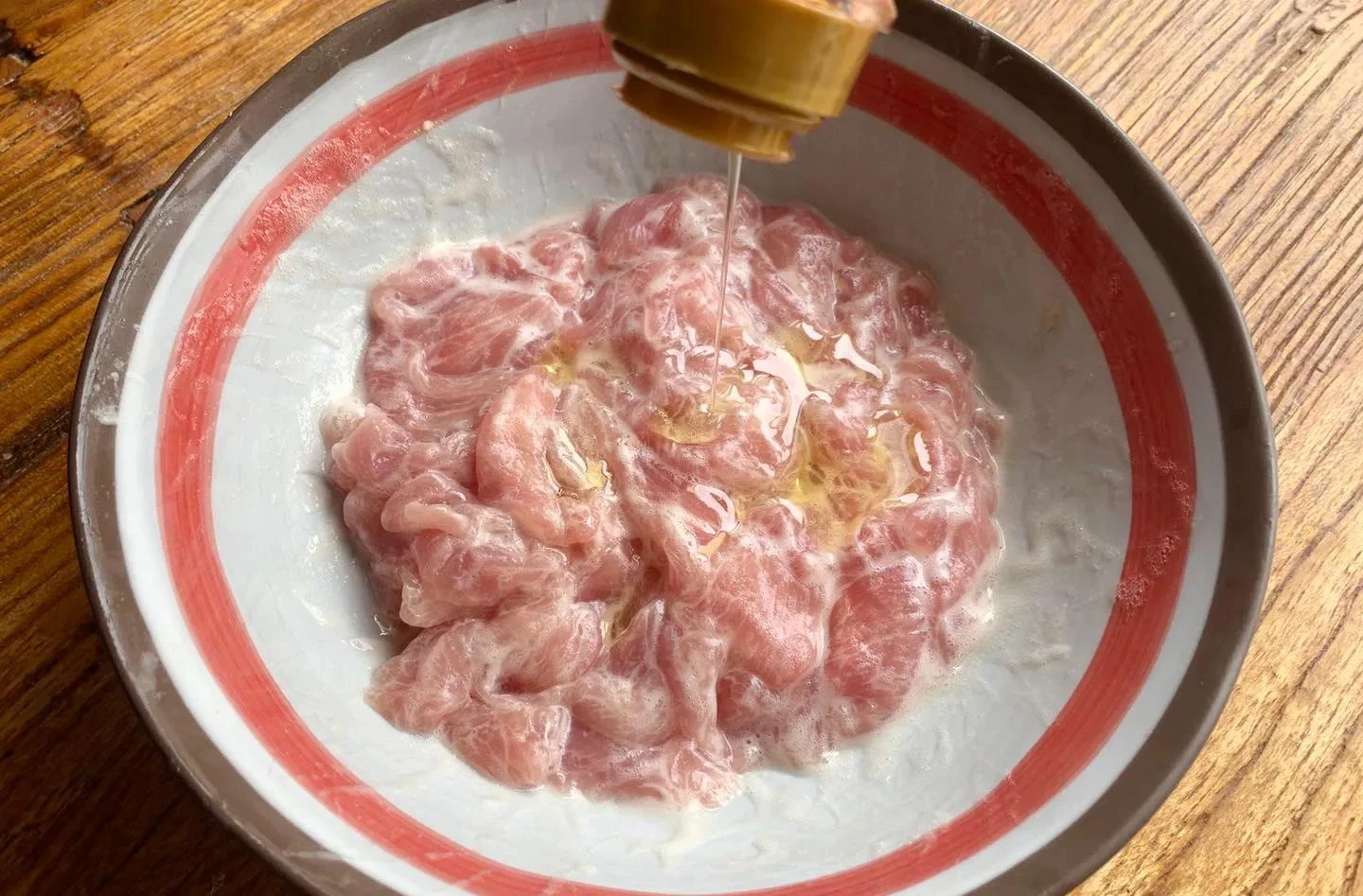
- Bowl B got the full Cantonese coat: one egg white, one tablespoon cornstarch, one teaspoon Shaoxing wine, one teaspoon light soy sauce, one teaspoon oil. Massaged for 30 seconds, rested for 15 minutes.
- Bowl C got the lazy coat: one tablespoon cornstarch, one teaspoon oil, a pinch of salt. No egg white, no wine, no resting. Five minutes of prep.
Bowl A followed its camp's instructions exactly: rinse, pat dry, straight into the hot wok. Bowls B and C took the oil pass — 45 seconds at around 130°C, until opaque, then drained. All three went into the same sauce and came out on the same three plates, unlabeled.
My partner, who does not read food science for a living, blind-tasted all three, then scored them on tenderness, texture integrity, flavor, sauce compatibility, and ease. I scored them too, and we argued until our scores converged.
| Treatment | Tenderness | Texture integrity | Flavor | Sauce compatibility | Ease | Total |
|---|---|---|---|---|---|---|
| Baking soda, 15 min | 9 | 6 | 5 | 7 | 9 | 36 |
| Egg white + cornstarch | 8 | 9 | 9 | 9 | 6 | 41 |
| Starch + oil only | 7 | 8 | 7 | 7 | 8 | 37 |
The baking soda batch was the most tender thing on the table — almost too tender. The edges had gone soft, even mealy, and a faint metallic note lingered in the meat that rinsing had not fully removed. It took the sauce well, but the chicken's own voice was muted, as if it had been interviewed through a pillow.
The egg white batch won on every sensory axis that matters at a dinner table: a clean bite, a silky surface, meat that tasted unmistakably like chicken, and a sauce that clung instead of sliding off. But it cost the most labor, and I confess a failure in its camp's name: the first time I cooked Bowl B's recipe, a year ago, I skipped the oil pass and dropped the coated slices straight into a hot wok. The coating shed into the sauce like fog. It tasted fine. It looked like regret.
The starch-and-oil batch was genuinely decent — the promised 70–80% of the full effect. Less cushion, slightly more chew, a faint wok-char the others lacked, no off-flavors. For a Tuesday, it is the right answer.
The verdict of the test is not that the egg white method is "better." It is that on thighs, which are already juicy, the baking soda method is solving a problem that doesn't exist — and paying for the solution in flavor. The winner depends on what's broken.
Mechanism: Break vs. Wrap
Baking soda is an alkali, and it works by raising the pH at the surface of the meat to somewhere around 8 or 9. At that alkalinity, the surface proteins begin to weaken and dissolve. The muscle fibers loosen their grip on each other, the meat's structure softens, and its ability to hold water changes. This is why it's fast, and why it's dangerous: the reaction does not stop at 20 minutes. It keeps going, and the longer it runs, the closer your dinner gets to the texture of a damp pencil eraser. The 15–20 minute window is my tested safe window, matching the short-treatment consensus of RecipeTinEats and ATK. Rinsing is not optional; it is the second half of the technique. For the deep science — pH curves, protein thermodynamics, the full story — see Velveting 101 — why velveting works.
Egg white and cornstarch work by an entirely opposite logic. The egg white's proteins, mostly ovalbumin, are globular molecules dissolved in water. Heat them to 60–70°C and they denature: they unfold, link arms with their neighbors, and set into a solid, continuous film. The cornstarch gelatinizes in the same heat, thickening the film and giving it that cushioning slip. The coating sets before the meat inside has even reached 50°C, sealing the moisture in while the interior is still essentially raw; the meat cooks gently inside its own shell. Every slice is a race: the shell sets at 60–70°C while the meat inside is still waking up. The shell always wins. The same cornstarch logic, applied to sauces instead of coatings, is the Starch Slurry Guide.
One honest trade-off: velveted chicken gives up surface Maillard browning — the roasted crust from searing a breast in a screaming pan is absent by design. What you gain is moisture; the browning comes back in the sauce, where it belongs.
The Chicken-Specific Protocol
For a proper velveted chicken — the kind that belongs in kung pao or gai lan with chicken — here is the procedure.
Slicing. Breast: 3–5mm slices, against the grain, on a slight bias. Thigh: 5–8mm, across the grain. Uniform thickness matters more than any single ingredient here; the coating cannot save a slice that is 3mm at one end and 12mm at the other.
The coat. Per 500g of chicken: one egg white, one tablespoon cornstarch (粟粉, sùfěn), one teaspoon Shaoxing wine, one teaspoon light soy sauce, one teaspoon oil. Massage for a full 30 seconds — not a stirring motion, a working of the marinade into the meat — then rest for 10–15 minutes.
The pass. Heat oil to 120–140°C, the low-fry stage, 四成热, four-tenths hot. No thermometer? The chopstick test in the Oil Temperature Guide will show you the stage exactly: a chopstick dipped in the oil should raise a thin, steady stream of fine bubbles, not a storm. Pass the chicken in small batches for 30–60 seconds, until the slices turn opaque and the coating sets. Do not brown them; drain on a rack or in a strainer. Alternatively — the weeknight-friendly version — slip the coated slices into barely simmering water for 30–45 seconds, until opaque, then drain.
The re-wok. The chicken is already cooked. The wok is not for cooking it; it is for warming it through and dressing it with sauce. High heat, aromatics first, then vegetables, then the passed chicken and the sauce, tossed just long enough to coat. If you find yourself stir-frying the chicken for more than a minute, you are re-cooking it, and all your velveting work was for nothing. This is also the step where most bland kung pao goes wrong — the flavor never catches up once the chicken has been cooked into submission.
Common Mistakes
The technique fails in four predictable ways, all of them errors this page has made so you do not have to.
Leaving the baking soda on too long. The reaction does not stop at 20 minutes — past that, the meat turns to paste and tastes of the softening agent. Treat 15–20 minutes as a ceiling, not a target, and always rinse.
Skipping the oil or water pass. The coating needs that gentle pass to set. Drop coated slices straight into a screaming wok and the coating sheds into the sauce like fog — it tastes fine, but it looks like regret. The pass is not a step. It is the technique.
Slicing unevenly. The coating cannot save a slice that is 3mm at one end and 12mm at the other — the thin end overcooks while the thick end never sets.
Skipping the rest. The 10–15 minute rest after the massage is not optional. Rushed into the oil, the coating slides off and pools in the pan.
Chicken Breast vs. Chicken Thigh
The single most useful question before any chicken touches a bowl: what cut is this, and what is its problem?
Chicken breast is lean, dry-prone, and structurally delicate. It is the cut velveting was invented to save, and it has two legitimate paths. If the breast is already dry and you need to rescue it tonight, use the baking soda break: half a teaspoon per 500g, 15–20 minutes, rinse, cook. If the breast is fine and you want it to stay that way through a real stir-fry, use the full egg white wrap. Both work — they are working on different parts of the problem.
Chicken thigh is naturally juicy, forgiving, and almost impossible to dry out in a stir-fry. It does not need the baking soda break — the face-off proved that baking soda on thighs buys you tenderness you didn't ask for and charges you flavor you will notice. A light starch-and-oil coat is enough. Save the egg white for the breast, or for a night when you want maximum silk.
The Substitutes Table
Velveting has a forgiving architecture. Every ingredient has a job, and most jobs have a replacement.
| Missing ingredient | Use instead | Honest expectation |
|---|---|---|
| Egg white | Starch + oil only (1 tbsp cornstarch + 1 tsp oil per 500g) | 70–80% of the full effect — the directional figure from this site's testing |
| Cornstarch | Potato starch or tapioca starch, 1:1 | Nearly identical; potato starch runs slightly glossier, tapioca slightly chewier — measured in this page's test |
| Shaoxing wine | Dry sherry | Close enough; the wine is for aroma, not structure |
| Egg allergy | The starch + oil path, always | 70–80%, non-negotiable; never reach for a creamy dairy substitute |
| Light soy sauce | A pinch of salt | The soy is for seasoning and color, not structure |
And the baking soda ratio, for the record: half a teaspoon per 500g, 15–20 minutes max, always rinsed. Missing three or more of these? The Substitution Calculator will sort you out faster than I can. Rebuilding the shelf itself? The Chinese Pantry Starter Kit walks through the first seven bottles that unlock the most dishes.
The One-Line Decision Rule
Breast? Break it or wrap it. Thigh? Wrap it lightly. Authentic Chinese stir-fry? Wrap it — egg white and cornstarch, then pass it through oil or water. Fast weeknight dinner with a dry breast? Break it — baking soda for 15–20 minutes, then rinse. Missing an ingredient? The table above. Don't pick a camp — pick a symptom: too dry, break it; can't hold moisture, wrap it.
FAQ
Q: Does velveting chicken need egg white?
No. Egg white is the structural engineer, but starch alone delivers an honest 70–80% of the effect. Use egg white when texture integrity matters most; use starch and oil when you just want dinner.
Q: Baking soda or cornstarch — which is better for velveting chicken?
They are not competing for the same job. Baking soda breaks chicken down; cornstarch (with or without egg white) wraps it up. Too dry, break it; can't hold moisture, wrap it. There is no absolute winner.
Q: Can I velvet chicken without cornstarch?
You can swap, but never skip the starch entirely: potato starch or tapioca starch substitute one-for-one. Without any starch, the coating will not set.
Q: How long can I leave baking soda on chicken?
The tested safe window is 15–20 minutes, and the clock does not pause. Past 20 minutes, the surface turns to paste and the meat tastes of the softening agent. Always rinse.
Q: Do I need to velvet chicken thighs?
No. Thighs are naturally juicy. A light starch-and-oil coat gives them the silky exterior and helps the sauce cling; the full egg white treatment is for breast.
Q: Can I velvet chicken in advance?
Coated, rested, and passed, chicken sits happily in the fridge for a few hours before the final wok. Never marinate with baking soda in advance — the break reaction doesn't stop just because you are at work. Set a timer. Rinse.
Q: What does 滑鸡 (huájī) mean?
Literally "slippery chicken" — a Cantonese term for chicken sliced, coated, and slipped through warm oil or water before stir-frying. The English "velvet chicken" translates that gliding quality.
Q: Why does my velveted chicken fall apart in the pan?
Two usual suspects: the baking soda ran too long and broke the meat down past the point of no return, or — far more common — you skipped the oil or water pass and the coating shed before it could set.
Continue Exploring
Written by Mike Sang
Digital strategist, fermentation science enthusiast, and student of the Tao. Bridging growth engineering with ancient Chinese food wisdom.
Seasonal Context
Flavor changes with the season. Your cooking should too.
Missing Umami is part of The Way of Nature, a living system connecting food, timing, and seasonal practice.