Editorial Guide
Velveting Beef — Cornstarch, Baking Soda, or Both?
Cornstarch wraps, baking soda weakens. They are two steps, not two camps — with ratios by cut, rinse rules, and why your beef turned mushy.
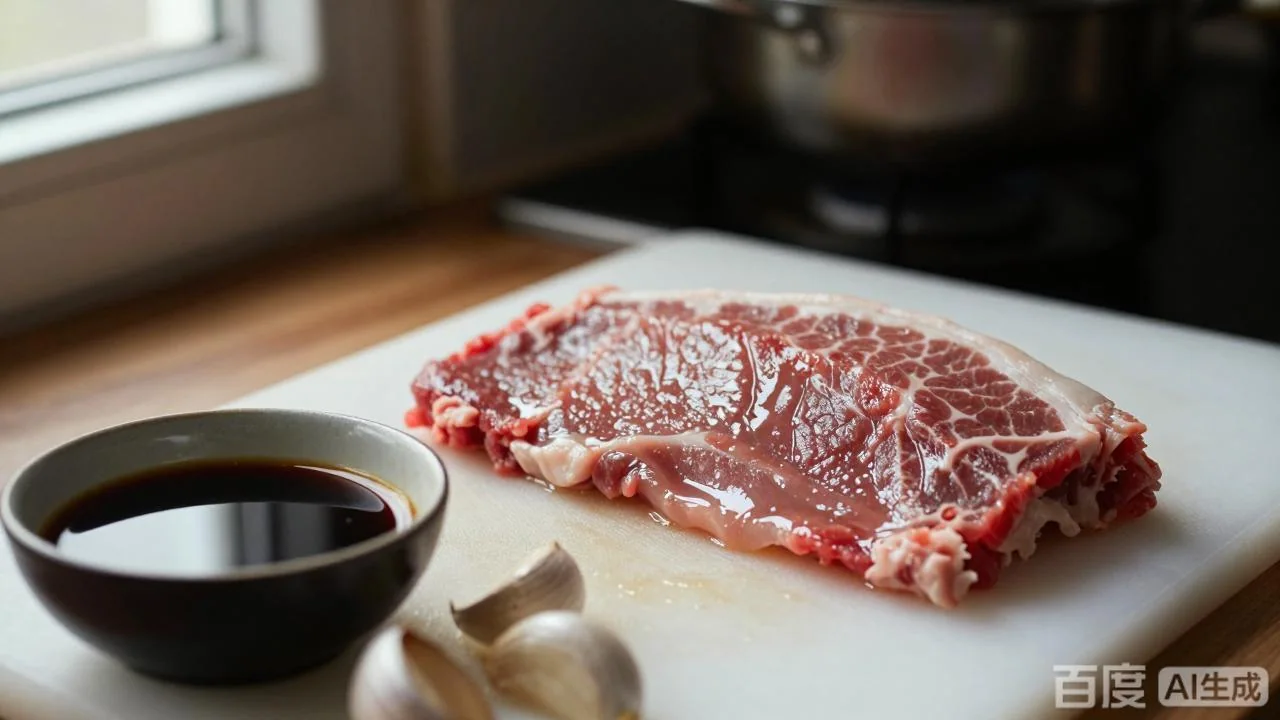
Type Editorial Guide
Linked Ingredients 2
Next Steps 5
If you searched "cornstarch vs baking soda," you've probably already read two kinds of articles that tell you the opposite thing. One says cornstarch is the "real" velveting method and baking soda is a shortcut that ruins meat. The other says baking soda is the secret restaurant trick and cornstarch is just for looks.
Both are wrong in the same way. Cornstarch and baking soda are not two camps competing for your 450 g of flank steak. They are two different tools that solve two different problems, and on a restaurant line they run one after the other.
Here's the one sentence that clears up the whole confusion: cornstarch makes beef slippery, baking soda makes beef tender. Slippery and tender are not the same goal, and once you can tell them apart, you stop asking "which one" and start asking "which do I actually want."
Key Takeaways
- Cornstarch and baking soda are two stations on the same line, not two rivals. Cornstarch is a physical coating — it locks in water, keeps the slices separate, and gives that glossy "slippery" mouthfeel. Baking soda is a chemical treatment — it raises the pH of the meat's surface, loosens the protein, and changes the meat itself. You can use either, or both, in sequence.
- Baking soda is a rescue tool, not a default. Reach for it on genuinely tough, lean cuts — flank, skirt, top round, chuck, blade. Skip it on ribeye, tenderloin, or anything marbled and already tender; you'll trade some texture and risk a soapy taste for nothing.
- The home ratio is roughly 450 g beef : ½ tsp baking soda : 1 tbsp cornstarch : 1 tbsp water or Shaoxing wine. Scale from there. Baking soda is measured in teaspoons, never tablespoons.
- If you use baking soda, you must rinse it off. Baking soda left on the meat tastes soapy and turns the surface unpleasantly slippery. Rinse well, then pat bone-dry before the starch goes on.
- Beef rests longer than chicken. Give it 20–30 minutes after the starch coat, not the 10–15 minutes chicken needs — beef fibers are thicker, and once sliced thin against the grain the meat has more exposed cut surface to protect.
Does velveting work on beef?
Yes — and for beef it works better than for almost anything else, because beef is the protein that most needs it. But "does it work" depends entirely on which cut you're holding. The honest answer is a cut-by-cut one, and this table is the most useful thing on the page:
| Cut | Velvet it? | Why |
|---|---|---|
| Flank / skirt | Yes — the classic candidates | Long, coarse fibers that stay chewy unless sliced thin and tenderized. Highest payoff from both cornstarch and baking soda. |
| Sirloin / sirloin tip | Yes | Moderately tough, decent flavor. A light baking-soda pass plus starch makes it slice-and-stir-fry friendly. |
| Top round / eye of round | Yes | Lean, dry, fibrous. This is the cut baking soda was practically invented for. |
| Chuck (sliced thin) | Yes, with the longest rest | Well-marbled but full of connective tissue. Fine for stir-fry only after slicing thin and velveting; otherwise this is a braising cut. |
| Ribeye / scotch fillet | No need | Richly marbled and tender. A starch coat is all you might want; baking soda just eats into its texture. |
| Tenderloin / filet mignon | No need | Already the most tender cut on the animal. Velveting here is spending effort to make something worse. |
| Wagyu | No | The point of wagyu is its own fat and texture. Treating it is like putting ketchup on a steak. |
| Shank / brisket | No — wrong tool entirely | These are dominated by collagen, not fiber. No surface treatment fixes them; they need low, slow, moist heat to turn collagen into gelatin. Velveting is the wrong answer. |
The pattern: velveting is for lean, fibrous, fast-cook cuts. If a cut is already tender because of marbling, velveting does nothing good. If a cut is tough because of connective tissue (shank, brisket), velveting can't reach the problem. It sits in the useful middle: tough-because-fibrous.
Why beef needs velveting at all
Three things go wrong when you stir-fry beef, and velveting is a fix for all three.
1. The fibers are long and coarse. Muscle is a bundle of long, parallel fibers — strands of myofibrils, each built from repeating contractile units called sarcomeres. In a heavily worked muscle (flank, round), those fibers run long and the connective tissue holding them together is dense. Bite straight down the length of a fiber and it's like biting through a rope.
2. Slicing thin against the grain cuts that rope into short pieces. (See the diagram below.) Slice with the grain and you get long chewy strands; slice across it and each piece is only a few millimeters of fiber, so your teeth never meet a long strand. This is a physics step, and it's free — but it's also the step home cooks skip most often.
3. High heat squeezes water out. Beef protein contracts sharply when it hits a hot wok. The muscle fibers tighten, squeeze out the water they were holding, and the slice goes from juicy to dry in seconds. This is the same reason a burger patty firms up as it cooks.
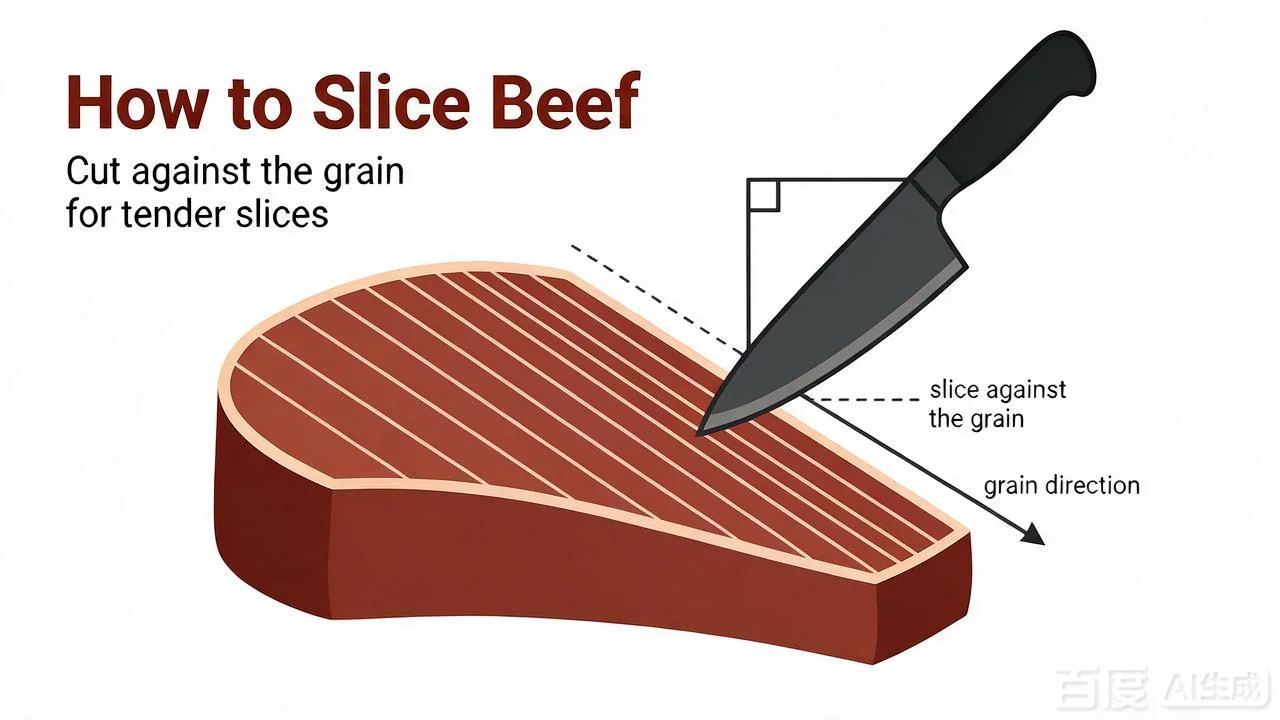
Velveting answers those last two at once: the starch coating buffers the meat from the direct heat of the oil (so the fibers contract less violently), and the baking soda chemically loosens the surface so it holds water instead of shedding it.
Cornstarch vs baking soda: two tools, two jobs
This is the table the search term is really asking for.
| Cornstarch | Baking soda | Both, in sequence | |
|---|---|---|---|
| What it does | Physical coating; gels on contact with heat into a film that locks in water and keeps slices from sticking | Chemical; raises surface pH and weakens the surface protein so it holds water | First chemical tenderizing, then physical coating — the restaurant sequence |
| The result on the plate | "Slippery," glossy, silky surface; meat holds its shape | Genuinely softer interior; slight loss of springiness | Both tender and slippery |
| Amount per 500 g | 1–1.5 tbsp | ½ tsp if you'll rinse; ~⅓ tsp if you won't | ½ tsp baking soda + 1 tbsp cornstarch |
| Rest time | 15–30 min | 15–30 min, then rinse | 15 min baking soda → rinse → starch |
| Rinse needed? | No | Yes — otherwise soapy taste | One rinse, between the two stages |
| Effect on texture | Surface only | Goes deeper into the surface layer | Both |
| Best for | Any cut; sauces and gravies that want body; shrimp and chicken too | Lean, tough cuts: flank, round, chuck, sirloin | Stir-fried beef slices and shreds |
| Risk | Too thick a coat mutes the beef's own flavor | Overdose → mushy surface and an alkaline, soapy taste | Fumbling either stage |
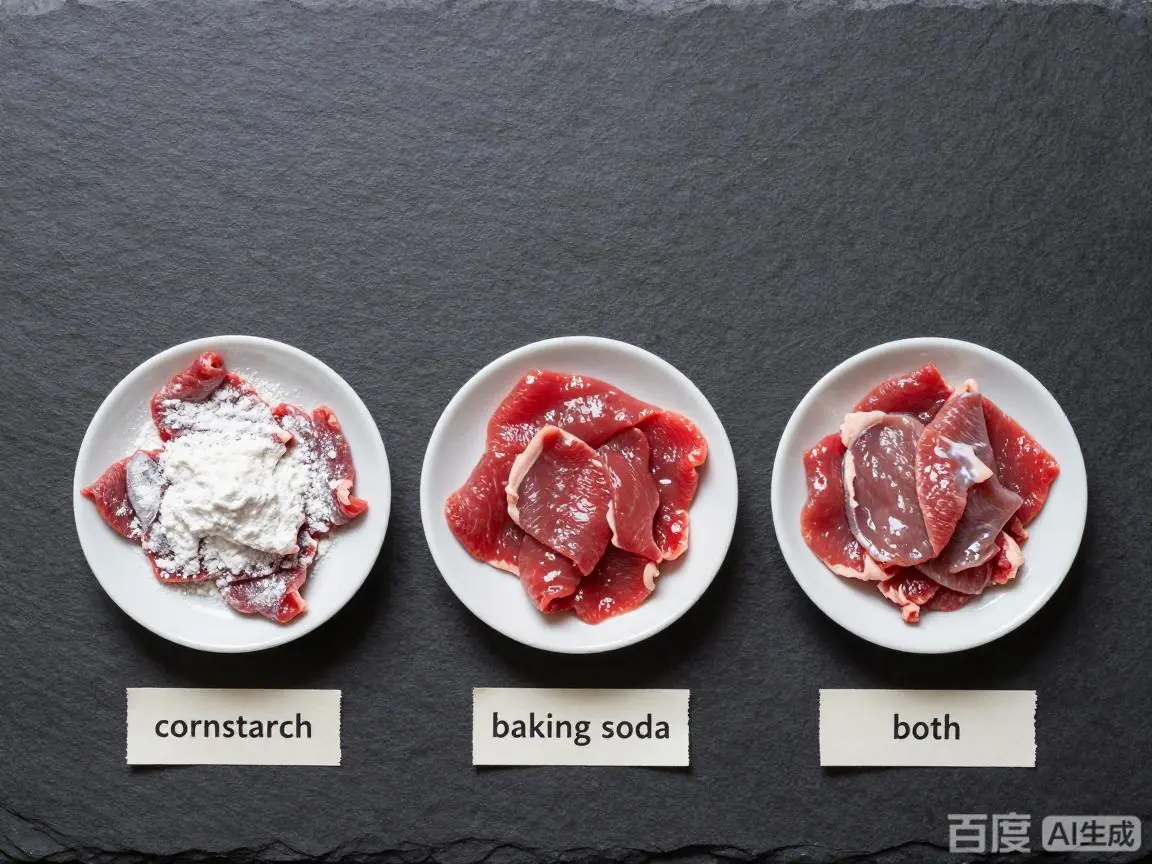
Read down the "What it does" column and the confusion evaporates. Cornstarch is doing upholstery work — wrapping the meat. Baking soda is doing chemistry — changing the meat. There is no version of this where one "beats" the other, because they aren't answering the same question.
The decision rule:
- If you only do one thing, do the cornstarch. It improves every cut, every time, with almost no downside.
- If the meat is genuinely tough, add baking soda — but rinse it.
- If you want restaurant results, do both, in order: baking soda first, rinse, then the starch coat.
How baking soda works (and why more isn't better)
Baking soda is sodium bicarbonate — a weak base. Its whole trick is pH.
Fresh meat sits at a pH of around 5.5, close to the isoelectric point of its main muscle proteins — the pH at which a protein carries no net charge and therefore holds the least water. Push the surface pH up, and those proteins pick up a net negative charge. Like charges repel, the protein network springs apart, and more water can be held in the widened spaces between the fibers. That much is well established in the meat-science literature on bicarbonate marination; the protein unwinds and holds water you would otherwise lose in the pan.
What that literature does not give you is a neat number — "raises pH by exactly X units." Anyone quoting a precise figure is usually quoting a single experiment on a single cut under lab conditions, not something you can transfer to half a teaspoon on your cutting board. The direction is what matters: more alkaline surface, more bound water, softer meat.
But the same mechanism is why the dose is tiny and the timer matters.
- At the right dose and time, the change is confined to the surface layer (roughly the outer millimeter or two). The interior is untouched — which is exactly what you want for thin slices.
- At too high a dose or too long a rest, the surface protein goes from loosened to broken down. The meat turns mushy and slick, and residual bicarbonate reads as a soapy, alkaline taste.
- A ½ tsp per 500 g is a seasoning-sized amount on purpose. Going up from there does not get you "more tender" — it gets you a different, worse texture.
This is also why every "how much baking soda" number you've read online seems to disagree with the rest. There are genuinely two correct doses, and most sources never say which one they're describing: a bigger rinse-off dose (about 1 tsp per 500 g) if you're going to wash it off before cooking, and a smaller leave-on dose (about ⅓ tsp per 500 g) if the soda goes into the pan with the meat. Pick the dose that matches your method and the numbers stop fighting.
The rinse rule: do you have to rinse after baking soda?
If you used baking soda, yes. Rinse it off — every time.
The reasons, in order of how much they matter:
- Taste. Left-on bicarbonate reads as a soapy, slightly metallic, "alkaline" flavor. It's the single most common complaint from first-time baking-soda users, and it's entirely avoidable.
- Texture. The residual powder keeps working on the surface, pushing the meat past "tender" into "slippery and mushy."
- Cooking. A wet alkaline coat throws off browning, and in a hot wok it can foam and spit.
How to rinse right:
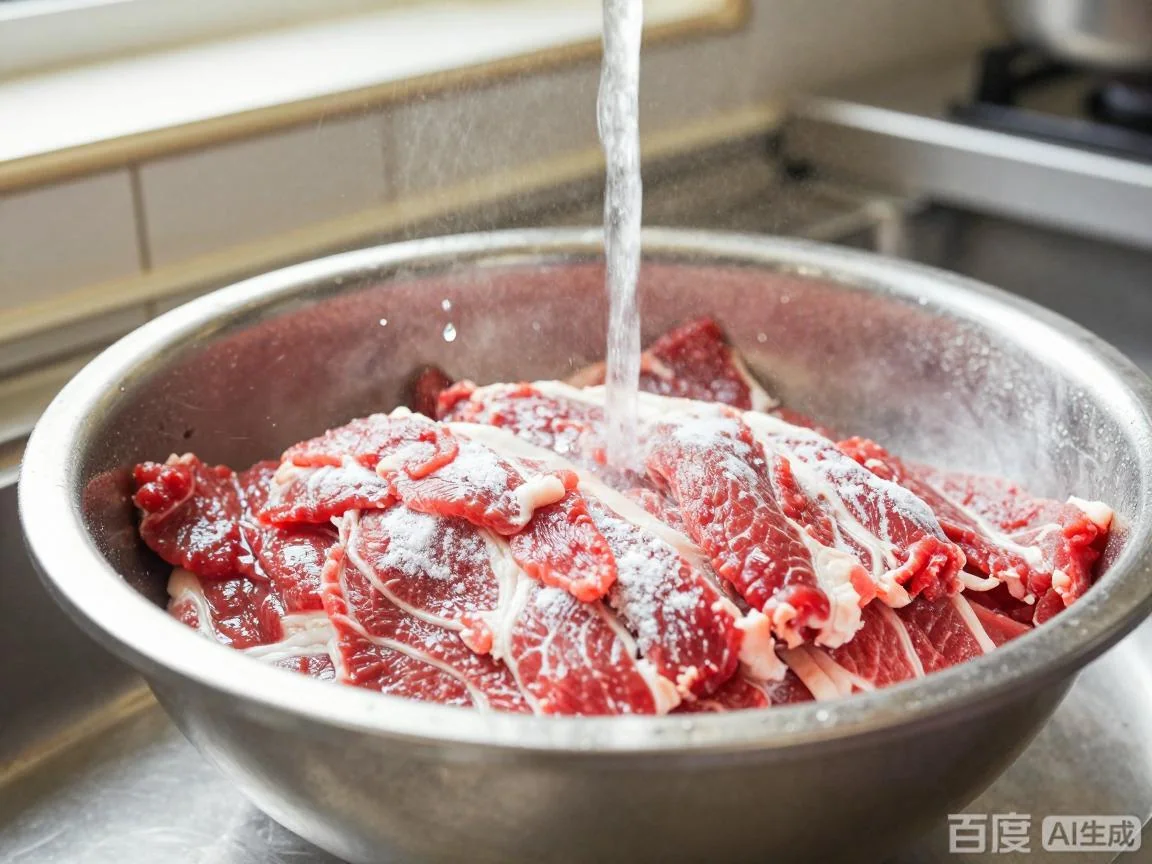
- Run the meat under cold running water for about 30 seconds, or dunk it in a bowl of cold water and swish a few times, until the surface no longer feels slick.
- Then pat it completely dry — paper towels, both sides, no shortcuts. If the meat is still wet, the starch coat you add next will slide off instead of clinging, and you'll get bald patches when it hits the oil.
- If you only used cornstarch, there's nothing to rinse. The starch is supposed to stay on. Just go straight to cooking.
Step by step: velveting beef at home
Twelve steps, in order. Skip nothing, but note which steps are the optional ones.
- Slice against the grain, 2–3 mm thick. Find the direction the fibers run, then cut across them. This is the single highest-value step and it's free.
- (Optional) Soak in cold water for 10 minutes to draw out blood and reduce gamey notes. Worth it for stronger-flavored cuts; skippable on clean sirloin.
- Pat completely dry with paper towels.
- (Optional) Add baking soda — ½ tsp per 500 g — and massage it in until every slice is coated.
- Rest 15 minutes. Not longer, or the surface over-softens.
- Rinse the baking soda off under cold water (only if you used it).
- Pat dry again. Thoroughly.
- Season and hydrate: add salt or light soy sauce, a splash of Shaoxing wine, and — if you like — an egg white. Toss in one direction until the liquid is absorbed and the meat feels tacky.
- Add the cornstarch — 1 tbsp per 500 g — and toss until every slice wears an even, thin coat.
- Add a tablespoon of oil and mix. The oil film keeps slices from gluing together in the bowl and in the wok.
- Rest, chilled, 20–30 minutes. This is the beef-specific part: longer than chicken.
- Blanch in oil — 160–180 °C — for 20–40 seconds, just until the slices turn opaque, then lift them out. Now they're ready for whatever stir-fry you're building.
Steps 2 and 4 are the two that are genuinely optional. Everything else is load-bearing.
Time and ratio by cut
Once you know the target — tender interior, no soapy taste — the numbers are a starting grid, not a measured optimum. Work within them and adjust to what your hand tells you.
| Cut | Baking soda (per 500 g) | Cornstarch (per 500 g) | Rest |
|---|---|---|---|
| Flank / skirt | ½ tsp | 1 tbsp | 30 min |
| Sirloin | ¼ tsp | 1 tbsp | 20 min |
| Top round / eye of round | ½ tsp | 1.5 tbsp | 30 min |
| Chuck (sliced for stir-fry) | ½ tsp | 1.5 tbsp | 30–40 min |
| Ribeye / tenderloin | none | 1 tsp | 10 min |
Two notes on reading the table:
- The leaner and coarser the cut, the more it benefits from the baking-soda pass — and the longer it can safely rest, because there's more tough fiber to work on.
- The already-tender cuts get cornstarch only, and a shorter rest. Adding baking soda there does nothing but risk the texture.
Troubleshooting: five ways velveting beef goes wrong
| What you see | What went wrong | The fix |
|---|---|---|
| Meat is mushy / slick | Too much baking soda, or it sat too long | Drop to ¼ tsp per 500 g and cut the rest to 20 minutes |
| Soapy, alkaline taste | Baking soda wasn't rinsed off | Rinse under cold water for a full 30 seconds |
| A pool of liquid in the wok | Meat wasn't patted dry before the starch, or the pan wasn't hot enough | Dry the meat completely; cook hotter and in smaller batches |
| The coating fell off | Oil temperature too low, so the starch never set | Bring the oil to 170–180 °C before the slices go in |
| Beef is still chewy | Under-rested, or not enough starch | Rest the full 30 minutes; add starch to 1.5 tbsp |
| A thick, pasty shell on the meat | Too much cornstarch | Tap off the excess before it hits the pan |
If you only remember one diagnostic: a soapy taste means rinse, a mushy surface means too much soda, and water in the pan means the meat was still wet.
The same technique outside the wok
The "can I velvet this?" question comes up for dishes that aren't stir-fries at all. Here's the honest answer for the ones people search for.
Beef and broccoli. The textbook application. Baking soda + cornstarch, and the velveting is what makes the beef come out of the sauce still tender instead of grey and tight.
Mongolian beef. Needs a generous starch coat and a hot, fast fry — the sugar in the sauce is the enemy of texture, so the coating has to do more work here.
Beef stroganoff. Be clear on this one: traditional stroganoff is not a velveting dish. Classic recipes call for tender cuts — sirloin, ribeye, tenderloin — seared hard and fast, and Russian and Western versions alike treat it as a quick-cook steak dish, not a tenderize-a-tough-cut dish. So velveting stroganoff isn't a tradition you're reviving. What it is: a useful move if you only have a leaner, tougher cut on hand (round, or a cheaper sirloin) and you'd rather not run out for steak. Treat the technique as a rescue — velvet the sliced beef, then proceed with the recipe. Just don't expect it to behave exactly like a properly marbled cut.
Beef jerky. Different goal entirely. Here the velveting isn't for tenderness — it's about the marinade. A light baking-soda pass and a starch coat help a lean cut hold onto its seasoning, and because jerky is dried rather than fried, the soda must be rinsed and the meat dried even more aggressively. This is a niche use; the mainstream jerky technique is a salt-and-sugar brine, cooked low.
The general principle: velveting is for "cook it fast, keep it tender." Anywhere that's your problem — including a weeknight stroganoff — it can help. It won't fix a dish whose whole logic is low-and-slow.
FAQ
Does velveting work on beef?
Yes, and beef benefits from it more than most proteins — but only on tough-because-fibrous cuts. Flank, skirt, sirloin, top round, and chuck (sliced thin) are the sweet spot. Skip it on ribeye, tenderloin, and wagyu, which are already tender. And it does nothing for connective-tissue cuts like shank or brisket, which need slow, moist cooking instead.
Do you have to rinse beef after velveting with baking soda?
Yes. Baking soda left on the surface tastes soapy and keeps softening the meat past the point of "tender" into "mushy." Rinse under cold water for about 30 seconds until the surface is no longer slick, then pat completely dry before adding the starch. If you only used cornstarch, there's nothing to rinse.
Cornstarch or baking soda for velveting beef?
They're not alternatives, they're stages. Cornstarch is a physical coating that locks in water and gives the meat its glossy "slippery" texture. Baking soda is a chemical treatment that raises the surface pH and genuinely softens tough fiber. Use cornstarch on any cut; add baking soda when the cut is lean and tough; use both, in that order, for restaurant-style results.
How long should you velvet beef?
For the cornstarch coat, 20–30 minutes — longer than chicken, because beef fibers are thicker. If you're using baking soda, that's a separate 15-minute treatment before the starch, followed by a rinse. Resting the beef in the starch much beyond 30 minutes doesn't make it more tender; the starch just starts to draw moisture back out.
What is the ratio for velveting beef?
Working from 500 g of sliced beef: ½ tsp baking soda (rinsed off), 1 tbsp cornstarch, about 1 tbsp of water or Shaoxing wine, plus a splash of oil to finish. Scale the soda down to ¼ tsp for tender-ish cuts like sirloin, and skip it entirely for ribeye and tenderloin.
Can you velvet beef without cornstarch?
Yes. Baking soda alone will tenderize, if you use it as a rinse-and-cook treatment. But you lose the coating that locks in water and keeps slices from sticking, so the result is softer without being silky — and, especially in a wok, more prone to shedding moisture. Cornstarch alone is the safer single-tool choice; baking soda alone is the specialist move.
If you want these doses next to the stove rather than on a screen — every beef, pork, shrimp and chicken cut on one sheet — that's the velveting cheat sheet PDF.
Related guides
- Velveting 101 — the technique from the ground up
- Velveting chicken — where the egg-white-vs-starch question actually matters
- Velveting pork — where fat content, not fibre, drives the decision
- Velveting shrimp — half the soda and cooler oil, because the goal is protection not repair
- Starch slurry guide — why starch thickens and clings at all
- Oil temperature guide — the 160–180 °C window, and what happens outside it
- Light soy sauce · Shaoxing wine — the two liquids in the marinade
On this page
- Key Takeaways
- Does velveting work on beef?
- Why beef needs velveting at all
- Cornstarch vs baking soda: two tools, two jobs
- How baking soda works (and why more isn't better)
- The rinse rule: do you have to rinse after baking soda?
- Step by step: velveting beef at home
- Time and ratio by cut
- Troubleshooting: five ways velveting beef goes wrong
- The same technique outside the wok
- FAQ
- Related guides
Continue Exploring

Written by Mike Sang
Digital strategist, fermentation science enthusiast, and student of the Tao. Bridging growth engineering with ancient Chinese food wisdom.
Seasonal Context
Flavor changes with the season. Your cooking should too.
Missing Umami is part of The Way of Nature, a living system connecting food, timing, and seasonal practice.