Editorial Guide
Velveting Pork — Seven Cuts, Seven Different Answers
Pork velveting depends on the cut, not the animal. Fat content sets the baking soda dose and the time — belly needs none, tenderloin needs most.
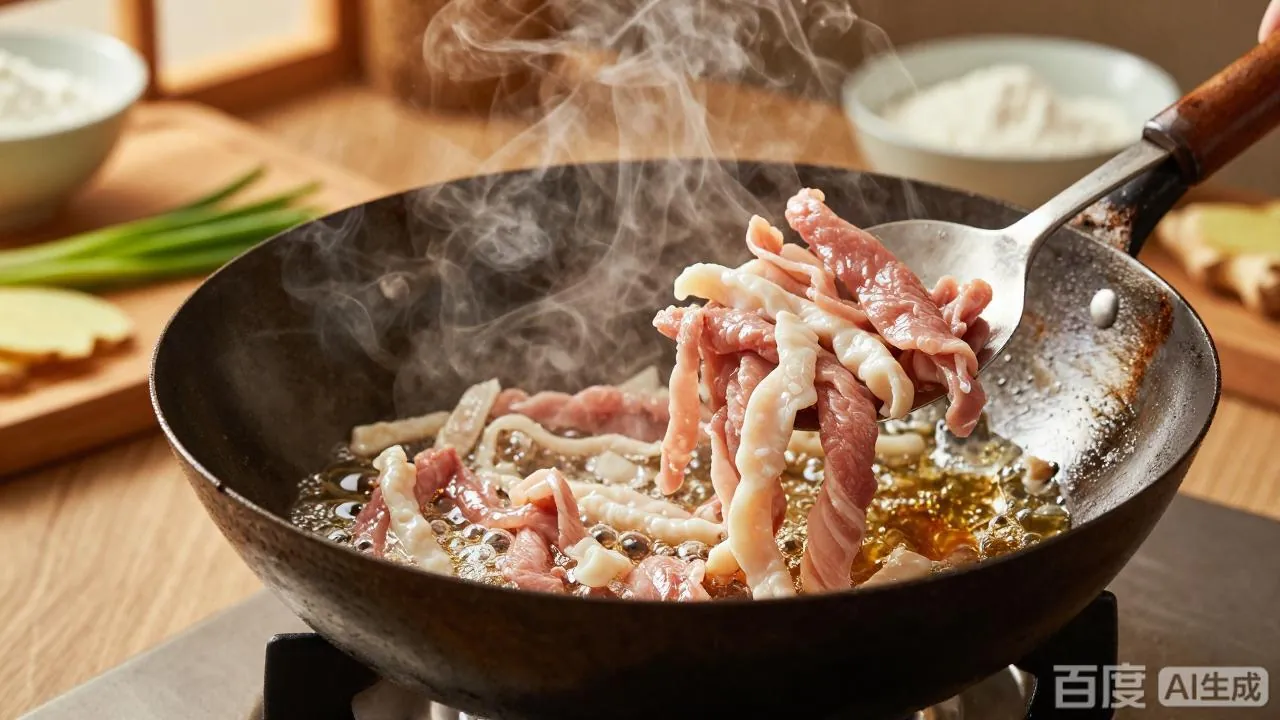
Type Editorial Guide
Linked Ingredients 2
Next Steps 6
Look at what people actually type into the search bar and the whole article writes itself: nobody searches "how to velvet pork." They search velveting pork belly. And velveting pork with baking soda. And velveting pork chops, pork tenderloin, pork loin, pork shoulder, pork fillet. Seven cuts, more than twenty phrasings.
That isn't noise. That's the answer. Pork isn't one ingredient, the way chicken breast is roughly one ingredient. The cut sitting on your board changes the recipe: how much baking soda you should use, whether you should use any at all, how long it rests, and whether velveting even helps.
So this page has one organizing idea, and everything else hangs off it: for pork, the variable that matters is fat — not the animal, and not your technique. Get the cut right and the numbers fall into place. Get it wrong and you'll velvet a pork belly with a tablespoon of baking soda and wonder why dinner tastes like soap.
Key Takeaways
- Pork velveting is a cut-by-cut decision, not a single recipe. The same technique spans a 4%-fat tenderloin and a 35%-fat belly, and those two want opposite treatment.
- Fat content sets the baking soda dose. Baking soda needs lean muscle protein to work on. The leaner the cut, the more it benefits — and the fatter the cut, the less it does and the more it risks.
- Pork belly does not need baking soda. It is already tender and rich; the point of velveting belly is the glossy coating for the sauce, not tenderizing. Adding soda there works on almost nothing and leaves a soapy note.
- Tenderloin and loin (about 4–7% fat) are the cuts velveting helps most — and shoulder/butt is the most forgiving to work with. Those two ends are the highest-signal searches for a reason.
- Bone-in chops are their own case. The bone creates a heat shadow and an uneven cook, so treat the heat differently from a boneless chop — though how much longer they need is genuinely argued about.
Why pork isn't chicken (and why the cut matters)
If you've read the chicken guide, you already know the technique. Pork adds a new variable and reshuffles the priorities.
Pork fibers are coarser than chicken, and the connective tissue varies wildly by cut. A tenderloin is a small, little-used muscle — short fibers, almost no connective tissue, and only about 3.9% fat by USDA measurement. A shoulder is a heavily worked muscle, laced with intramuscular fat and collagen. Same animal; they behave nothing alike in a wok. (This is why the beef guide and this one share a logic the chicken page doesn't have: which muscle is doing the work.)
Fat changes how the coating behaves. Fat renders as it heats, and rendered fat pushes against the starch coat from underneath. On a lean cut, the starch film sits on firm muscle and stays put. On a fatty cut, the surface is moving and greasy, and a heavy coat slides rather than clings — which is exactly why the lean-cut rules turn into failures on a belly.
Pork also carries a bit more funk than chicken or beef. It's the one protein where a quick soak or blanch before the marinade is genuinely worth it for stronger-tasting cuts — a step that's usually pointless on chicken.
And pork gets cut into everything. Shreds for a stir-fry, slices for a sauce, chunks for sweet-and-sour, matchsticks for a julienne. Shape decides how much surface the marinade has to protect, which decides how long you rest it. A 2 mm shred is mostly surface; a 2 cm chunk is mostly interior.
The cut-by-cut table (the most useful thing on this page)
Read the fat column first and everything after it stops being arbitrary.
| Cut | Common names | Fat (approx) | Connective tissue | Goal of velveting | Baking soda / 500 g | Rest | Starch / 500 g |
|---|---|---|---|---|---|---|---|
| Pork belly | side pork, pork belly slabs | ~36% | medium | Glaze, cling, set the coat — not tenderize | none | 5 min | 1 tsp (thin) |
| Pork shoulder | Boston butt, picnic shoulder, pork butt | ~12% | high | Tenderize + cling; the all-rounder | ¼ tsp | 15–20 min | 1 tbsp |
| Pork tenderloin | pork loin filet, pork fillet | ~3.9% | very low | Stop it going dry — the highest payoff | ½ tsp | 20–30 min | 1 tbsp |
| Pork loin chop | center-cut chop, rib chop | ~7% | medium | Stop it going dry + hold shape | ¼ tsp | 15 min | 1 tbsp |
| Pork fillet | tenderloin tips, smaller fillets | ~4–6% | very low | Stop it going dry | ½ tsp | 20 min | 1 tbsp |
| Pork leg | fresh ham, leg roast (sliced) | ~5% | high | Tenderize sliced leg | ½ tsp | 20–30 min | 1 tbsp |
| Pork roast | shoulder roast, loin roast (in blocks) | by cut | by cut | Usually not velveted as a block | 0–¼ tsp | by use | by use |
Two ground rules sit underneath the table, and they're the whole article in two lines:
- Lower fat → more baking soda, longer rest. The leaner the cut, the more there is to gain and the more the lean protein can take.
- Higher fat → less baking soda, or none. Fat layers have no protein for the soda to loosen, so you're paying the soapy-taste price for a benefit that isn't there.
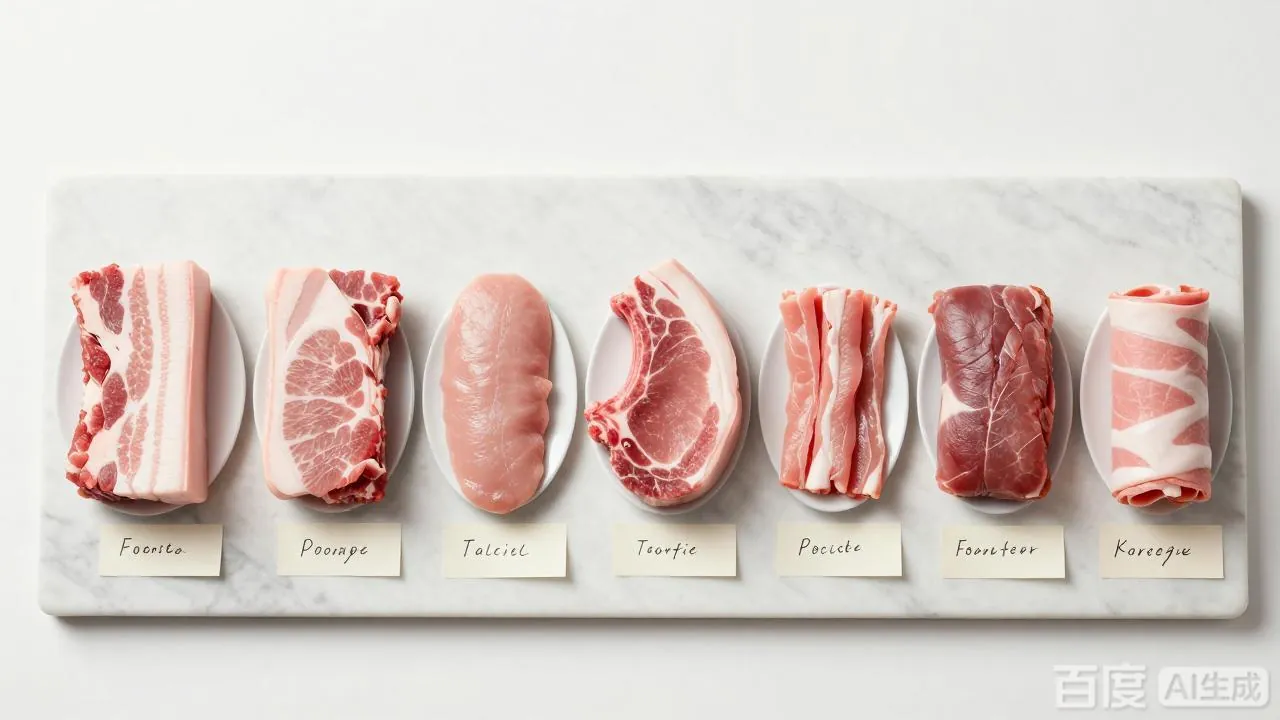
Where those fat numbers come from — and why the belly figure keeps changing
This matters more than it sounds, because the belly number has moved.
USDA's current Foundation Foods entry for raw pork belly (with skin) measures 35.8 g fat per 100 g across six samples, ranging 30.6 to 41.9. The older SR Legacy database carried a higher figure — around 53 g — for a differently trimmed "separable lean and fat" cut. Both numbers float around the internet, and neither is wrong so much as measuring a different piece of pork.
What actually decides your belly's fat content is how the butcher trimmed it. A whole slab with the skin and fat cap intact is not the same product as the thin, trimmed slice sold for stir-frying, and the gap between those two is wider than the gap between the two databases.
The tenderloin figure is the firmest of the set: 3.9 g per 100 g, eight samples, range 2.35 to 5.34 (USDA FDC 2646169). Loin chops sit near 7 g, sliced leg near 5 g, and Boston butt near 12 g — those last three from the older database, since Foundation Foods has no separate shoulder entry.
The exact figure moves with breed, trim, and the butcher's knife. The order of the cuts never moves, and the order is what you're cooking by.
Does velveting work on pork?
Yes — but "works" means different things on different cuts, and pretending otherwise is how people end up disappointed.
| Cut | Velvet it? | What you're actually buying |
|---|---|---|
| Pork tenderloin / loin | Yes — the classic candidate | The leanest, driest pork there is. Velveting is doing real work here: holding water that the meat would otherwise lose at wok heat. |
| Pork shoulder / butt | Yes — happily | Enough fat to forgive small mistakes, enough muscle to benefit from a light soda pass. The most forgiving cut on the list. |
| Pork leg (sliced) | Yes, with a longer rest | Lean and fibrous; benefits like a tenderloin, but the surface is tougher, so it wants the full 20–30 minutes. |
| Pork belly | Only for the coating | Belly doesn't need tenderizing — it's the tenderest, richest part of the pig. Velvet it if the dish wants a glossy sauce to cling (sweet-and-sour, glazed stir-fries). Skip the baking soda. |
| Pork chops (boneless) | Yes | Loin-muscle meat, lean-ish, dries out easily. A light treatment helps a fast sear or a stir-fry. |
| Pork chops (bone-in) | Yes, but adjust | The bone makes the cook uneven (see below), so keep the marinade short and manage the heat rather than the marinade. |
| Pork roast (as a block) | Usually no | A block roast is a low-and-slow or oven project, not a fast-cook one. Slicing it after roasting is a different job from velveting. |
The pattern is the mirror image of beef: velveting pays off in proportion to how lean and fast-cooking the cut is. Tenderloin, loin, and sliced leg are where it earns its place. Belly is where people reach for it out of habit and get nothing but a slippery surface.
Belly: why the biggest search term is the one that needs it least
"Velveting pork belly" is the single most-searched phrase in this whole cluster, and the answer surprises people: you don't need to tenderize belly, because belly is already tender. Velveting a belly is like baking soda-ing a ribeye — you're spending effort to make something worse.
What belly does want depends on the dish:
- If you're making sweet-and-sour pork or a glazed stir-fry, the point is a coat that clings and browns. A thin dusting of starch (about 1 tsp per 500 g) plus a teaspoon of oil, rested just five minutes, gives you that without a heavy shell.
- If you're making twice-cooked pork (回锅肉), the belly is simmered whole first and then sliced and stir-fried — no velveting at all. The cooking, not a marinade, is what makes it tender.
- If you're stir-frying thin belly slices hard, a very light cornstarch coat keeps them glossy and stops them sticking, and that's the whole of it.
If you've been adding a teaspoon of baking soda to belly because a video told you to, that's the soapy note you've been tasting. Baking soda works on muscle protein, and the fat layers have none at all — so on a belly you're treating a fraction of the surface with the full dose, and leaving an alkaline film on a cut that never needed help.
Shoulder / butt: the most forgiving cut
Shoulder is what I reach for when I just want dinner to work. It has enough intramuscular fat that it stays juicy even if your timing slips, and enough muscle that a light soda pass still improves it.
- Baking soda: ¼ tsp per 500 g. Enough to do something, little enough that an extra minute of rest won't ruin it.
- Rest: 15–20 minutes. Shorter than tenderloin, because the fat is already doing part of the work.
- Starch: 1 tbsp per 500 g, plus a splash of water or Shaoxing wine and a teaspoon of oil.
- Watch for: the coat sliding off. Fat renders under the starch film; if your oil is too cool, the film never sets and you get pale, greasy pieces instead of browned ones.
If you only cook pork one way, learn it on shoulder. It's where the technique tells you what you did wrong instead of punishing you for it.
Tenderloin, loin, and fillet: the cuts velveting was made for
This is the payoff end of the fat spectrum, and it's the reason the "tenderloin" searches run so high. Tenderloin is about 3.9% fat — lean enough that it has almost no internal moisture buffer, so the second it hits a hot wok it starts shedding water and tightening. A coat is the only thing standing between it and dry, grey slices.
- Baking soda: ½ tsp per 500 g — the full-strength dose, because there's real lean protein to work on.
- Rest: 20–30 minutes. Lean, compact muscle wants the longer end.
- Starch: 1 tbsp per 500 g, with an egg white if you want maximum silk.
- After the soda: rinse it — see the rinse rule below. Tenderloin takes on a soapy note even more readily than beef because there's so little fat to mask it.
Loin chops sit just up the fat scale at about 7%. Same method, gentler dose: ¼ tsp soda, 15 minutes, 1 tbsp starch. Pork fillet (the smaller tenderloin pieces) behaves like tenderloin; treat it the same.
Bone-in chops: the one adjustment that isn't about fat
A bone-in chop breaks the neat fat rule, because the problem isn't the meat — it's the bone.
The bone does not conduct heat the way the surrounding muscle does, and it physically shields the strip of meat pressed against it. Two things follow in practice, and both are about heat rather than marinade:
- The cook is less even, and the meat in the bone's shadow lags the rest of the chop. Cooks who treat a bone-in chop exactly like a boneless one of the same thickness tend to end up with one part done and another underdone.
- Timing has to change. Bone-in chops generally need a little longer over heat, and many recipes deliberately start them in a cold pan and flip them repeatedly to even the cook out.
For a bone-in chop, the velveting adjustment is to keep the marinade short and light (¼ tsp soda, 15 minutes) and then rely on technique — moderate heat, a cold-pan start, or a bone-side-down sear. Don't try to solve a bone problem with more marinade.
A note of honesty: the exact effect of the bone is genuinely debated among cooks — some argue bone-in actually speeds the interior, others that it slows it. Treat "a little longer" as a sensible default, not a law of physics. The part that is certain is that a bone-in chop and a boneless chop of the same thickness are different cooking problems, and treating them identically is the mistake.
Three velveting methods, tuned for pork
Most pork marinade arguments are really arguments about which of these three you're using.
| Method | Ratio (per 500 g) | Time | Best cuts | What it does |
|---|---|---|---|---|
| Classic (egg white + starch + wine) | ½ egg white + 1 tbsp starch + 1 tbsp Shaoxing wine | 20 min, chilled | Tenderloin, fillet, sliced leg | Tender + silky; the most forgiving on lean muscle |
| Baking soda (lean-cut method) | ¼–½ tsp soda + 1 tbsp starch + 1 tbsp water | 15–30 min, then rinse | Tenderloin, fillet, sliced leg | Strongest water-holding; the real tenderizer |
| Starch-only (fatty-cut method) | 1 tsp starch + 1 tsp oil | 5 min | Belly, marbled shoulder | Cling and gloss; does not change the meat |
The choice isn't ideological. Lean cut → you can afford baking soda, and it pays. Fatty cut → starch and oil only, because soda has little to act on and everything to spoil.
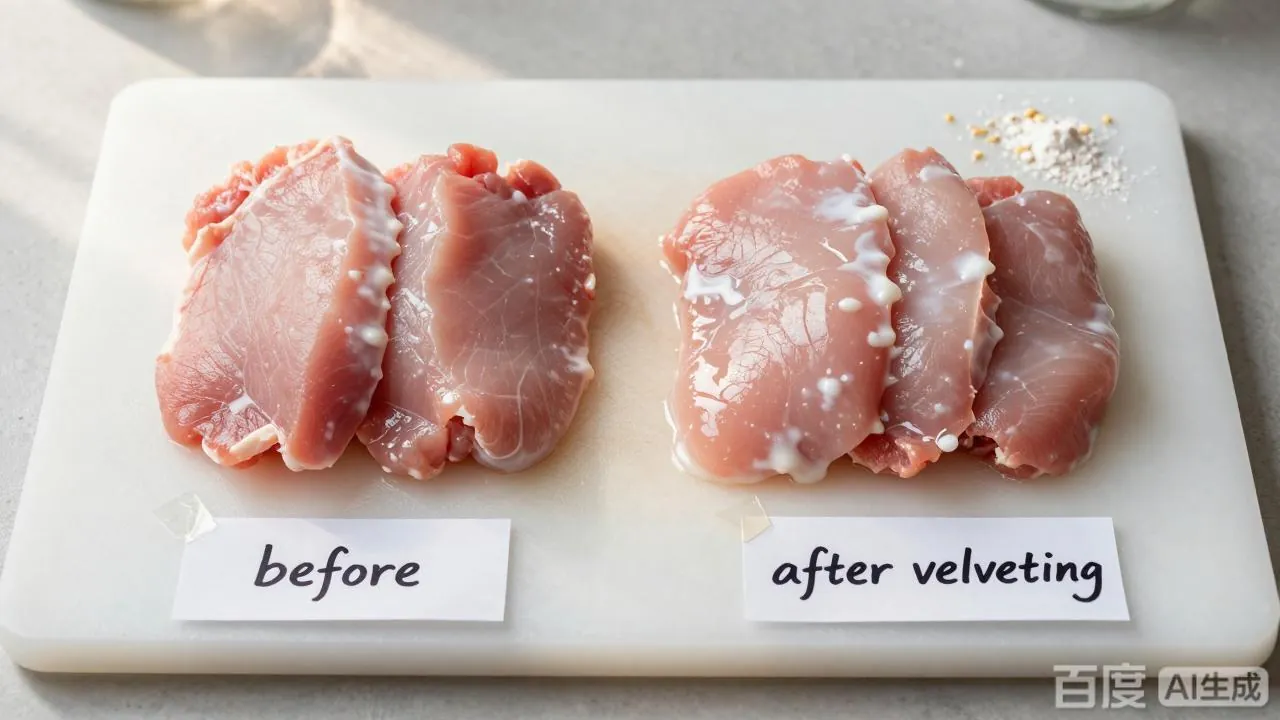
The "before" side is what your wok is up against: bare, matte, already losing surface moisture. The "after" side is a physical barrier the heat has to get through first.
How baking soda works on pork (and why fatty cuts gain least)
Baking soda is sodium bicarbonate — a weak base — and its whole trick is pH.
Fresh pork sits at a muscle pH of about 5.5, close to the isoelectric point of its main muscle proteins — the pH at which a protein carries no net charge and therefore holds the least water. Raise that surface pH, and the proteins pick up a net negative charge. Like charges repel, the protein network springs apart, and water moves into the widened spaces between the fibers. Research on bicarbonate treatment of pork shows the effect directly: it lowers drip loss and cooking loss and improves water-holding capacity.
That's why it works so well on tenderloin — and why it does almost nothing on belly. Baking soda changes protein, and the fat layers of a belly have no protein in them. A cut that is a third fat by weight has much less muscle to work on, and the fat cap contributes nothing, so the benefit shrinks toward zero. What doesn't shrink is the downside: bicarbonate misuse produces off-odours and an alkaline taste, and on a fatty cut there's less lean meat to hide behind.
Two more reasons the dose stays tiny:
- The change is skin-deep, and you want it to be. At the right dose the pH shift is confined to the outer millimetre or two — ideal for thin slices. Push the dose or the time and the surface protein goes from loosened to broken down, and the meat turns mushy and slick.
- The dose conflicts you've read online are two methods, not one. A larger dose — roughly 1 tsp per 500 g — is correct if you rinse it off before cooking. A smaller one — roughly ⅓ tsp per 500 g — is correct if the soda stays on and goes into the pan. Most recipes quote one and describe the other. Pick the dose that matches your method and the numbers stop fighting.
A common myth about the legal limit
You will find Chinese-language articles stating that the national standard caps sodium bicarbonate residue in meat at 0.3%. It does not.
GB 2760-2024, the food additive standard, lists sodium bicarbonate (碳酸氢钠) as a processing aid under Table C.1 — the list of aids usable in all food processing where no residue limit is specified (残留量不需限定). There is no 0.3% ceiling anywhere in it.
That number almost certainly drifted over from the dosing distinction above — ⅓ tsp per 500 g is the leave-on amount, and somewhere along the way a dose became a legal limit. They are unrelated, and it's a good illustration of why a figure repeated across many pages is not a figure that has been checked.
So the real considerations with baking soda are taste (the alkaline note if you don't rinse) and sodium intake, not toxicity at kitchen doses.
The rinse rule: do you have to rinse pork after baking soda?
If you used baking soda, yes — every time. Pork has less fat to mask an alkaline taste than beef, so this matters here even more.
- Taste. Left-on bicarbonate reads soapy and slightly metallic. On a lean cut it's the first thing you notice.
- Texture. Residual powder keeps working, pushing the surface past "tender" into "slippery."
- Cooking. A wet, alkaline surface browns unevenly and can foam in a hot wok.
How to rinse: cold running water for about 30 seconds, or a quick dunk and swish in a bowl of cold water, until the surface stops feeling slick. Then pat it bone-dry — if the meat is wet, the starch coat you add next slides right off. And if you used starch only, there's nothing to rinse; the starch is supposed to stay.
Step by step: velveting pork at home
Twelve steps. The two optional ones are marked.
- Choose the cut and cut it to shape. Shreds or 2 mm slices for a stir-fry; 2 cm chunks for a braise-and-glaze. Against the grain where the cut allows.
- (Optional) Soak in cold water for 10 minutes to draw out blood and reduce pork's funk. Most worth it on shoulder and leg; skippable on clean tenderloin.
- Pat completely dry with paper towels.
- (Optional — belly and marbled cuts should skip it) Add baking soda. ½ tsp per 500 g on tenderloin/fillet/leg; ¼ tsp on shoulder and chop; none on belly. Massage until every piece is coated.
- Rest 15 minutes (lean cuts up to 30). Not longer, or the surface over-softens.
- Rinse the soda off under cold water — only if you used it.
- Pat dry again. Thoroughly.
- Season and hydrate: salt or light soy sauce, a splash of Shaoxing wine, and an egg white if you want more silk. Toss one direction until the liquid is absorbed and the meat feels tacky.
- Add the starch — 1 tbsp per 500 g for lean cuts, 1 tsp for belly — and toss until every piece wears an even, thin coat.
- Add a teaspoon of oil and mix. The film stops the pieces gluing together.
- Rest, chilled. 20–30 minutes for lean cuts; just 5 for belly and other fatty cuts.
- Blanch in oil at 160–180 °C for 20–40 seconds, just until the pork turns opaque and lifts. Now it's ready for the dish.
Steps 2 and 4 are the optional ones. Everything else carries weight.
Time and ratio by cut
Once the goal is clear — tender inside, no soapy note — the numbers are just a starting grid.
| Cut | Baking soda / 500 g | Starch / 500 g | Rest |
|---|---|---|---|
| Pork belly | none | 1 tsp | 5 min |
| Pork shoulder / butt | ¼ tsp | 1 tbsp | 15–20 min |
| Pork tenderloin / fillet | ½ tsp | 1 tbsp | 20–30 min |
| Pork loin chop (boneless) | ¼ tsp | 1 tbsp | 15 min |
| Pork loin chop (bone-in) | ¼ tsp | 1 tbsp | 15 min (short) |
| Pork leg (sliced) | ½ tsp | 1 tbsp | 20–30 min |
| Pork roast (block) | 0–¼ tsp | by use | by use |
The logic reads straight down the fat column: the leaner the cut, the stronger the soda pass and the longer it can safely rest.
Troubleshooting: how velveting pork goes wrong
| What you see | What went wrong | The fix |
|---|---|---|
| Meat weeps, the stir-fry turns wet | Not patted dry before the starch | Dry the surface completely; cook hotter, in batches |
| The coat slides off in the oil | Oil too cool, or the meat wasn't chilled | Bring the oil to 170 °C+; chill 15 min so the coat sets |
| Mushy, no spring | Baking soda overused — especially on a fatty cut | Belly needs none; drop lean cuts to ¼ tsp |
| Soapy aftertaste | Soda wasn't rinsed | Rinse under cold water a full 30 seconds |
| A pasty, floury shell | Too much starch | Tap off the excess before it hits the pan |
| Bone-in chop uneven, dry outside | Bone creates a heat shadow; cooked like a boneless chop | Start cold-pan and flip, or sear bone-side down; keep the marinade light |
One diagnostic line to remember: water in the pan means wet meat, mush means too much soda, soap means rinse, and an uneven bone-in chop means the bone, not the marinade.
The same technique outside the stir-fry
A few dishes people search "velveting pork" alongside, and the honest answer for each:
Sweet-and-sour pork. The classic velveting-adjacent dish. Here the coat does double duty — it holds moisture and becomes the crisp shell, so the starch goes up (roughly double) and the pieces are fried rather than blanched. Shoulder or belly, both fine; no baking soda.
Shredded pork stir-fry. The most basic application, and the one where velveting pays most. Tenderloin or leg, shredded fine — Chinese recipes commonly specify about 6 cm by 3 mm — soda-treated, starched, blanched at around 110–140 °C, then finished with the vegetables.
Twice-cooked pork (回锅肉). Not a velveting dish at all. The belly is simmered whole, chilled, sliced, and then stir-fried. The cooking is the tenderizer; there's no marinade in sight.
Char siu. Also not velveting. It's a whole-piece marinade for a roast, not a fast-cook prep for thin cuts. Different project.
The general principle is the same one as beef, with a pork twist: velveting is for "cook it fast, keep lean meat juicy." It scales with leanness. On belly it's the wrong tool.
FAQ
Should you velvet pork belly?
For tenderizing, no — belly is already tender, and baking soda has little lean protein to work on, so it mainly adds an alkaline, soapy note. Velvet belly only when the dish wants a coat that clings and glistens (sweet-and-sour, glazed stir-fries), and use starch plus a little oil, not soda.
How much baking soda for velveting pork?
It depends on the cut. Tenderloin, fillet, and sliced leg: ½ tsp per 500 g, rinsed off. Shoulder and chop: ¼ tsp. Belly: none. If you're leaving the soda on instead of rinsing, use about a third of those amounts.
Do you have to rinse pork after velveting with baking soda?
Yes, if you used it. Rinse under cold running water for about 30 seconds until the surface is no longer slick, then pat completely dry before the starch goes on. Pork masks an alkaline taste even less well than beef, so skipping this is the most common mistake.
Can you velvet pork chops?
Yes — both boneless and bone-in. Use a light treatment (¼ tsp soda, 15 minutes, 1 tbsp starch). With bone-in chops, keep the marinade short and manage the heat for the bone's heat shadow rather than leaning harder on the marinade.
What is the best cut of pork for stir-fry?
For payoff, tenderloin and loin — lean enough that velveting genuinely rescues them. For forgiveness, shoulder/butt — enough fat to stay juicy if your timing slips, enough muscle to still improve with a light treatment. Belly is for dishes where you want richness and a clinging glaze, not leanness.
Can you velvet pork with cornstarch only?
Yes, and on fatty cuts you should. Cornstarch alone gives you the coating, the gloss, and the water-locking film without touching the meat — which is all a belly or a marbled shoulder needs. Reserve the baking-soda pass for genuinely lean cuts, where there's protein for it to soften.
The whole cut-by-cut grid — beef, pork, shrimp and chicken, with the soda dose and oil temperature for each — is in the velveting cheat sheet PDF.
Related guides
- Velveting 101 — the technique from the ground up
- Velveting chicken — where the egg-white-vs-starch question actually matters
- Velveting beef — cornstarch vs baking soda as two stages
- Velveting shrimp — where the oil runs cooler, not hotter
- Oil temperature guide — the 160–180 °C window, and what happens outside it
- Starch slurry guide — why starch thickens and clings at all
- Light soy sauce · Shaoxing wine — the two liquids in the marinade
On this page
- Key Takeaways
- Why pork isn't chicken (and why the cut matters)
- The cut-by-cut table (the most useful thing on this page)
- Does velveting work on pork?
- Belly: why the biggest search term is the one that needs it least
- Shoulder / butt: the most forgiving cut
- Tenderloin, loin, and fillet: the cuts velveting was made for
- Bone-in chops: the one adjustment that isn't about fat
- Three velveting methods, tuned for pork
- How baking soda works on pork (and why fatty cuts gain least)
- The rinse rule: do you have to rinse pork after baking soda?
- Step by step: velveting pork at home
- Time and ratio by cut
- Troubleshooting: how velveting pork goes wrong
- The same technique outside the stir-fry
- FAQ
- Related guides
Continue Exploring

Written by Mike Sang
Digital strategist, fermentation science enthusiast, and student of the Tao. Bridging growth engineering with ancient Chinese food wisdom.
Seasonal Context
Flavor changes with the season. Your cooking should too.
Missing Umami is part of The Way of Nature, a living system connecting food, timing, and seasonal practice.